Sunday, 17 January 2016

What Donald Trump’s Plaza Deal Reveals About His White House Bid


Photo
“To me the Plaza was like a great painting,” Donald Trump said of the hotel he agreed to buy in 1988 and later lost in bankruptcy. “It wasn’t purely about the bottom line.” Credit Benno Friedman/Corbis
The day Donald Trump called and asked for a one-on-one meeting in the winter of 1988, Tom Barrack was a relative newcomer to the high-stakes poker game of New York real estate. He had worked for nearly two years for Robert Bass, the Texas billionaire investor, and had played an important role in winning the Plaza Hotel for his boss the year before. Mr. Trump was the country’s most quotable and ostentatious financial celebrity, a guy with a jet, a 282-foot yacht and a fondness for peach-toned marble.
But among the people he negotiated with, Mr. Trump had a reputation for both steeliness and finesse. So Mr. Barrack was wary. A mere four months after Mr. Bass had taken control of the Plaza, he gave Mr. Barrack the go-ahead to put it up for auction. Mr. Trump was calling to say, in effect, skip the auction. We’ll strike a deal, the two of us, right here in my office.
“Just come over,” Mr. Trump said, in Mr. Barrack’s recollection. “Give me half an hour.”
Mr. Barrack was soon sitting in Mr. Trump’s office in Trump Tower on Fifth Avenue. The two had met a few times, because Mr. Trump had been angling to acquire the Plaza for years. Now that it was going back on the market, Mr. Trump didn’t want to miss out.
“How can I live without it?” Mr. Trump asked, gesturing to the Plaza, which could be seen from his window, just two blocks north. “It’s right in my backyard.”
“You should own it,” Mr. Barrack replied. “But you’re going to have to pay for it.”
Mr. Trump quickly agreed to a price of slightly more than $400 million, an unprecedented sum for a hotel at the time. Just a few years later, the Plaza wound up in bankruptcy protection, part of a vast and humiliating restructuring of some $900 million of personal debt that Mr. Trump owed to a consortium of banks. Never one for regrets, Mr. Trump today regards the purchase as a triumph.
“To me the Plaza was like a great painting,” he said in an interview in late December. “It wasn’t purely about the bottom line. I have many assets like that and the end result is that they are always much more valuable than what you paid for them.”
How Mr. Trump came to own, operate and then lose the Plaza reveals a lot about his business style. For decades, Mr. Trump has boasted of his boardroom skills in self-exalting speeches and books. As the front-runner in the Republican presidential race, he frequently argues that his corner-office prowess uniquely suits him to negotiate with world leaders.
What does this prowess look like up close? In the Plaza tale, Mr. Trump demonstrated both strengths (an ability to charm or strong-arm, as the occasion required) and weaknesses (a kind of hungry impatience that left him searching for new trophies as soon as one had been acquired). His methods as a political candidate mirror his methods as an executive, say those who have dealt with the latter and seen the former. In fact, the more you know about Mr. Trump’s past, the more his run for high office looks like an effort to close the biggest deal of his life.
Photo
The Plaza Hotel in 1988, around the time Donald Trump bought it for $407 million. Credit Fred R. Conrad/The New York Times
“He has the ability to imagine what the other party wants him to be and then be that person,” said Michael D’Antonio, author of “Never Enough: Donald Trump and the Pursuit of Success.” “He presents the Trump that will work in the moment.”

A Disarming Dealmaker

When Mr. Trump made that call to Mr. Barrack he was 41 and New York City’s showiest developer. Then, as now, his braggadocio could sound like a parody of braggadocio. There was, for instance, the moment in 1984 when he told The Washington Post he could handle the United States’ side of nuclear arms talks with the Soviets.
“It would take an hour and a half to learn everything there is to learn about missiles,” he boasted. “I think I know most of it anyway.”
By 1987, he had casinos in Atlantic City, a mansion in Palm Beach, Trump Tower, all the trappings of an up-and-coming tycoon, along with a best seller, “The Art of the Deal.” What Mr. Trump lacked was the kind of old-money Manhattan landmark that would add prestige to his portfolio.
The Plaza, which he’d been yearning to buy since his mid-20s, was that landmark. The hotel had opened in 1907, a 19-story French Renaissance “chateau” with roughly 800 rooms. It billed itself as “the world’s most luxurious hotel,” and over the years its habitués included F. Scott Fitzgerald, Marlene Dietrich and Frank Lloyd Wright, who lived there while construction of the Guggenheim Museum was underway. When the Beatles performed on “The Ed Sullivan Show” in 1964, they stayed at the Plaza.
Photo
Thomas Barrack Jr., the aspiring deal maker who orchestrated the sale of the Plaza to Mr. Trump. Credit Peter Foley/Bloomberg
Mr. Bass came into possession of the Plaza when he, along with a Japanese corporation, bought its owner, the Westin chain. Mr. Bass was enamored with the hotel’s history and cachet, but he had little experience in the hospitality industry.
As Mr. Bass pondered the matter, Mr. Barrack, who was based in Manhattan, started to appreciate that the Plaza could fetch an irresistible price. By February 1988, he was readying an auction.
It was around this time that Mr. Trump picked up the phone and requested that half-hour meeting with Mr. Barrack at Trump Tower.
To understand what happened next, you need to know that in every real estate deal, the two big variables are price and contingencies. The latter come after an initial purchase price is agreed to and are essentially conditions demanded by the buyer after a thorough inspection of the property. A condition could be a problem with the plumbing, the roof or a thousand other particulars, and every condition can reduce the price of the property. With a building as old as the Plaza, a proper inspection could take months and include union contracts and an assortment of licenses for food and drink.
On the phone, when Mr. Trump asked him to abandon the auction, Mr. Barrack initially thought it was a ploy related to contingencies.
“I told him: ‘You’re too good. You’ll want to buy it and it will get tied up in all these contingencies.’ He said, ‘No, it’ll be a real deal.’ I said, ‘No contingencies.’”
Photo
Outside the Plaza Hotel in 1991. Credit James Estrin/The New York Times
Once in Mr. Trump’s office, the haggling began. Mr. Barrack said he expected 10 to 15 participants in the coming auction and an ultimate price as high as $500 million. What if I gave you $390 million today? Mr. Trump asked. Mr. Bass has an offer of $410 million in hand, Mr. Barrack countered. Mr. Trump raised his bid, and they settled on a final price of $407.5 million.
“Then he did something amazing,” Mr. Barrack recalled. “He said: ‘You’ve owned the property for four months. I want you to tell me everything that’s wrong with it and how to fix it. I said, ‘We just said, no contingencies.’ He said: ‘This is not in a contract. Nothing in writing. Just tell me what is wrong with the property and how to fix it.’”
In essence, Mr. Trump was telling Mr. Barrack that he trusted him to disclose everything that a team of lawyers and inspectors would typically need at least 90 days to unearth. It was like asking an enemy for a map of a minefield. And by saying, in effect, “I’m at your mercy and will believe what you tell me,” Mr. Trump was appealing to Mr. Barrack’s integrity. Which was very disarming.
Mr. Barrack thought over Mr. Trump’s question for a moment. He had already worked out most of the major problems.
“The biggest issue,” he told Mr. Trump, “is Fannie Lowenstein.”
He was referring to a woman, who might have been in her 80s, who lived by herself in a tiny, rent-controlled apartment in the Plaza. With Ms. Lowenstein there, reconfiguring the building as a condominium or a co-op, which was Mr. Trump’s plan and the only way to justify the $407 million price tag, would be far more difficult. But she had adamantly refused to give up her rent-control rights and move to a larger apartment in the Plaza.
“I’ll do the deal in a week, for $407.5 million,” Mr. Trump said, “and you take care of Fannie Lowenstein. All I want at the closing is to hear that Fannie Lowenstein is happy.”
Mr. Barrack left the meeting in a daze, both thrilled and anxious.
“It was a genius deal for Trump,” Mr. Barrack said, “because while an auction would have fetched a bigger initial price, it would have been tangled up in contingencies. And he’d just convinced me to fix everything for him.”
Mr. Trump had correctly sized up Mr. Barrack: someone who was trying to prove himself and wanted a major coup.
“He kind of looked at me and said, ‘I’ll make you a star,’” said Mr. Barrack, who now runs Colony Capital, a real estate investment firm based in Los Angeles with 300 employees. “It’s the same talent on display when he gives political speeches. He reads an entire crowd with the same precision that he reads an individual.”
For Mr. Barrack, winning over Ms. Lowenstein was a project. She knew more about tenant law than any lawyer, and for the next two months, the two spoke four or five times a week. He ultimately offered her an apartment in the Plaza that was almost 10 times as large as her studio apartment, with a view of Central Park. Rent-free. For life. Also, new furniture, new dishes, new everything. She grudgingly agreed. But she also wanted a piano. She got a Steinway.
Photo
Ivana Trump outside the Plaza in 1987. Once he owned the hotel, Mr. Trump put Ivana, his wife, in charge of renovating it, paying her, as he put it at the time, “one dollar a year plus all the dresses she can buy.” Credit Joe McNally/Getty Images
To Mr. Barrack’s amazement, Mr. Trump handled nearly all of the negotiations for the Plaza himself. Much as Mr. Trump is doing in his current campaign, which is notably lacking in consultants and pollsters, he operated largely by gut instinct.
When Mr. Trump did consult outside counsel about the Plaza, his instructions were to make as little trouble as possible, no matter how daunting the numbers looked.
“He toned me down,” recalled Jonathan A. Bernstein, then a lawyer at Dreyer & Traub. “He had come to the conclusion that this was a deal he wanted to do, and he was completely aware of the downsides, and my job was to get him the best legal document I could. You don’t tell him, ‘Are you crazy?’ You say: ‘It’s $400 million and $12 million in N.O.I.,’” or net operating income. “‘Are you O.K. with that?’”

Huge Debt, Lost Prize

Once he owned the hotel, Mr. Trump put his wife, Ivana, in charge of renovating it, paying her, as he put it at the time, “one dollar a year plus all the dresses she can buy.” She and a team oversaw a restoration that included new paint, new furniture and a revival of the major public spaces, like the Palm Court tearoom.
“Some of it came out great; some of it came out kind of chintzy,” said Barbara Res, then an employee of the Trump Organization. “We went about trying to restore it but in a way that didn’t cost too much money.”
Photo
The Plaza’s logo.
Mr. Trump offered design opinions and growled when necessary. After a hotel union put up resistance to changes requested by his wife — that ashtrays be regularly stamped with the Plaza’s logo, for instance — Mr. Trump issued a threat.
“I called these guys up,” he told The New York Times soon after the purchase, “and said, ‘Do it, or I’ll turn the Plaza into a condo with three janitors and a super.’”
Opinion was split over the merits of the deal. Among the many who thought that Donald Trump had overpaid was Donald Trump. In a full-page ad he took out in New York magazine in November 1988, he called the transaction “the first time in my life I have knowingly made a deal which was not economic — for I can never justify the price I paid, no matter how successful the Plaza becomes.”
This proved prescient. By 1990, the Plaza needed an operating profit of $40 million a year to break even, according to financial records that Mr. Trump disclosed at the time. The hotel had fallen well short of that goal, and with renovating expenses, in one year it burned through $74 million more than it brought in.
But Mr. Trump didn’t spend a lot of time sweating over the Plaza’s finances. He was too busy with new challenges. A few months after the Plaza deal closed, he purchased the Eastern Air Shuttle for $365 million, and in 1990, he opened the Trump Taj Mahal casino in Atlantic City, which cost $1 billion to build. Some of the loans he took out to pay for deals were personally guaranteed.
“The fact is, you do feel invulnerable,” Mr. Trump told Timothy O’Brien, author of “Trump Nation,” discussing this period in his life. “And then you have a tendency to take your eye off the ball a little bit and hunt around for women. And hunt around for models.”

A lack of focus was not Mr. Trump’s only problem. The updraft in the real estate market of the ’80s turned into a headwind by the early ’90s, and more than $3 billion in loans — $900 million of which were personally guaranteed — went into default. Dozens of banks came calling and, after lengthy negotiations, a meeting was held in a large conference room in the law offices of Weil, Gotshal & Manges, the firm that represented the largest lender, Citibank. There, some 50 bankers and lawyers watched Mr. Trump sign over nearly all of his properties — the Plaza, other buildings, the shuttle, the yacht, the jet — in exchange for more favorable terms on his personal guarantees.
The banks could have easily toppled Mr. Trump into personal bankruptcy, “but we all agreed that he’d be better alive than dead,” said Alan Pomerantz, then head of the real estate department at Weil. “We needed him to help sell all of his assets, and the deal was that as he sold off more, we’d reduce his personal guarantee.”
In effect, the banks allowed Mr. Trump to remain solvent so that they could get the benefit of his gift for salesmanship. In exchange, the banks provided him with $450,000 a month to operate his business and cover personal expenses. It was so tight a leash that when Marla Maples, his girlfriend at the time, turned up on television waving the costly Harry Winston diamond she’d been given as an engagement ring, the paymasters wanted a word with the groom-to-be.
“I didn’t buy it,” Mr. Trump said, according to Mr. Pomerantz. It was a three-month loaner, given in exchange for on-air mentions of Harry Winston.
A spokeswoman for Mr. Trump called that story “completely false.”
The banks shopped the Plaza around, without success, for a few years before finally selling it in a deal that valued it at $325 million to a partnership between Prince Alwaleed bin Talal of Saudi Arabia and CDL Hotels International of Singapore in 1995. None of the proceeds went to Mr. Trump, according to several people involved.
Photo
Donald Trump beside a model of Trump Tower in 1980. By 1987, he had casinos in Atlantic City, a mansion in Palm Beach and Trump Tower — all the trappings of an up-and-coming tycoon. Credit Don Hogan Charles/The New York Times
Still, he told me that the sale was yet another victory. The terms were, to use one of his favorite words, fantastic, and relieved him of a vast personal debt.
“One of the great deals was the Plaza, because way beyond the price, I was able to get favors from the banks and from others,” he said. Speaking of Prince Alwaleed, he added: “He paid too much for the hotel. He wanted that hotel so badly, and I put him through the wringer and made a great deal.”
Of course, it cost the Saudi-Singapore partnership $75 million less than Mr. Trump had spent for the same building seven years earlier. Mr. Trump also claimed in the interview that he owned 100 percent of the Plaza until the day it was sold, a version of events totally at odds with published reports at the time and the recollections of others involved in the deal.
This may be yet another parallel to Mr. Trump’s performance on the hustings, where he has bent the truth into so many outlandish shapes that PolitiFact anointed his entire campaign the 2015 Lie of the Year. Among the more memorable whoppers: a Twitter post that 81 percent of whites are killed by blacks (PolitiFact cites the true figure as 15 percent) and that on television he’d seen thousands of people in Jersey City cheering the collapse of the World Trade Center.
Mr. Trump’s prediction that the Plaza would be worth far more than it cost him did come true. Unfortunately for him, it happened in 2004, when the hotel was sold yet again, this time for $675 million to an Israeli developer who carved up the rooms in the way that Mr. Trump had originally imagined. Half of the building was turned into condominiums, which eventually sold for a total of $1.4 billion.

Feuding With the Prince

Today, Mr. Trump’s brief ownership of the Plaza is one of the least-known chapters of a protean career. It was not the last time one of his properties would need the shelter of bankruptcy protection, and it marked the beginning of his transition from an owner of major assets to a manager of major assets. An increasing share of his wealth would come in the future from licensing his name, not just to builders but sellers of suits, cologne, chandeliers, mattresses and more. In professional parlance, he went from “asset heavy” to “asset light.”
Photo
Prince Alwaleed bin Talal of Saudi Arabia, who bought the Plaza after Donald Trump’s bankruptcy, in a partnership with CDL Hotels International. Credit Saleh Rifai/Associated Press
The Plaza deal also demonstrated both his intense drive and ambition as well as his tendency to spread himself dangerously thin as he looks for other conquests. Abraham Wallach, a former executive at the Trump Organization, said Mr. Trump was a man without any conventional vices, but he had a hopeless addiction to notoriety and was always prowling for another deal that would gain attention and enhance his status.
“I’ve been shocked he has demonstrated such focus during the presidential campaign,” Mr. Wallach said. “In business, he would focus for about two or three days before the closing, and after that he would lose interest.”
Recently, the hotel and a central character in this narrative have intersected with his presidential run. After Mr. Trump called in December for a “complete shutdown” on Muslims’ entry into the United States, Prince Alwaleed posted on Twitter: “You are a disgrace not only to the G.O.P. but to all America. Withdraw from the U.S. presidential race as you will never win.”
Mr. Trump returned fire: “Dopey Prince @Alwaleed_Talal wants to control our U.S. politicians with daddy’s money. Can’t do it when I get elected.”
That same day, Dec. 11, Mr. Trump gave a speech at a luncheon where he was heckled by protesters waving signs that read, “Stop the war on immigrant communities” and “Trump, making America hate again.” Several people were ejected from the building.
The building was the Plaza Hotel.

source: NYT

Jada Pinkett Smith comments on diversity at Oscars


After nominations were announced Thursday morning, many quickly took note of the fact that for the second consecutive year, all 20 acting nominees are white. Academy president Cheryl Boone Isaacs said she was “disappointed” by the results as well, and on Saturday Smith also responded on social media.
“At the Oscars…people of color are always welcomed to give out awards…even entertain, but we are rarely recognized for our artistic accomplishments,” she wrote on her Facebook and Twitter pages. “Should people of color refrain from participating all together? People can only treat us in the way in which we allow. With much respect in the midst of deep disappointment, J.”
Pinkett Smith’s husband, Will Smith, is one of the contenders who missed out on an Oscar nomination this year (for his role in Concussion), along with Idris Elba (Beasts of No Nation), Michael B. Jordan (Creed), Oscar Isaac (Ex Machina), Benicio Del Toro (Sicario), Tessa Thompson (Creed), and Jason Mitchell (Straight Outta Compton). Creed and Straight Outta Compton were also left off this year’s list of nominees for Best Picture.
Will Packer, one of the producers of Straight Outta Compton, also addressed the lack of representation in this year’s nominees.” “To my Academy colleagues, WE HAVE TO DO BETTER. Period,” he wrote in a Facebook post on Friday. “The reason the rest of the world looks at us like we have no clue is because in 2016 it’s a complete embarrassment to say that the heights of cinematic achievement have only been reached by white people. I repeat — it’s embarrassing.”

Saturday, 16 January 2016

Alessandra Ambrosio, Cristiano Ronaldo: Model and Footballer front sexy for GQ cover


Alessandra Ambrosio and Cristiano Ronaldo stripped off to grace the cover of GQ's latest body issue. 
Alessandra Ambrosio and Cristiano Ronaldo  Alessandra Ambrosio and Cristiano Ronaldo
(dailymail)
The super model and famous footballer where photographed all cozy and excited by each other side, the 34-years-old Alessandra wraps her arm around Cristiano's ripped shoulders while suggestively pulling down on his silver chain.
While Cristiano show off super washboard abs as he flexes his bulging muscles wearing nothing but a pair of tiny red swimming trunks. 

The photoshoot was shot sometime in October last year and both celebs pulled the magazine cover serving so much hotness in just one photo.

Friday, 15 January 2016

Danny Welbeck: Injured Arsenal striker set to return


Arsene Wenger has revealed that he is expecting Danny Welbeck back in action soon and rules out any move for a striker


Arsenal striker, Danny Welbeck  is just two weeks away from returning from a long term injury according to Gunners boss Arsene Wenger.
The 24-year-old Welbeck underwent surgery on his left knee last year after struggling to progress in his rehabilitation following an injury.
   (Arsenal FC via Getty Images)

The former Manchester United striker has not played since damaging the knee after coming on as a late substitute in a 0-0 draw with Chelsea on April 26.
Many have urged Wenger to bring in a striker in the January transfer window to aid their Premier League title pursuit, but the Arsenal manager has revealed that Welbeck is coming back soon.
I would prefer to have the players back from injuries,” Wenger said.
Welbeck is two to three weeks away and I am confident I will not find a better player than Welbeck on the market.”
Wenger could have fit-again Alexis Sanchez for Arsenal’s trip to Stoke City on Sunday but the manage ris concerned about the way he uses the forward.
Alexis Sanchez pulls his hamstring  Alexis Sanchez pulls his hamstring
(Kevin Quigley/Daily Mail)

Sanchez has two decisive days. Today and tomorrow. He’s fit,” Wenger said.
Do we take a gamble or not on his injury?
New signing Mohamed Elneny is eligible to play in the game after his move from Basel.
New Arsenal signing, Mohamed Elneny in training  Mohamed Elneny is available for selection against Stoke City (Arsenal FC via Getty Images)

He’s a defensive midfielder who can contribute in an area where we are short,” added Wenger.
He is also a promising player who has already adapted to Europe, he is not straight from Egypt to England — he has played three years in Switzerland.
I expect him to develop into a very strong player because he has both sides of the game, he can defend and he can attack and that's the way we want to play in midfield.
He is available for selection, I haven’t decided yet. I have to see how everyone has recovered. Apparently we have no injuries from the Liverpool game, so he is a possibility to be in the squad for Sunday.”

Chelsea coach, Guus Hiddink admits relegation fears


Chelsea coach Guus Hiddink admits relegation is realistic and called on his players to step up

Chelsea coach Guus Hiddink a a press conference ahead of their game with Everton  Guus Hiddink says relegation for Chelsea is realistic (Chelsea FC/Press Association Images)


Chelsea manager Guus Hiddink has admitted that they are currently in the relegation battles.
The current Premier League have lost nine games out of 21 and currently sit in 14th position just six points above the relegation zone and 12 points off fourth place.
Hiddink says relegation is realistic and called on his players to step up.

Chelsea dressing room better under Hiddink, says Mikel  Hiddink has called on his players to step up (Reuters)

It's a very realistic view,” Chelsea interim boss said.
Twelve points to fourth, that's Tottenham.
We all like to look up to the top of the table but don't be unrealistic when you're six points off the relegation line. That's also a fact.

We must work hard and be very concentrated and step up. That's why it was a pity about the 86th minute equaliser we conceded against West Brom.
When I arrived, we started one point off the relegation line and now we have more room to breathe.
We have two difficult games coming up. Everton, a very good away record, and then Arsenal. If you don't gather points, you don't know what the others do.”

Thursday, 14 January 2016

Three Winners Split $1.586B Powerball Jackpot


Record sales drove up the largest jackpot in US history to a whopping $1.586 billion as people dreaming of riches flocked across state lines and international borders to buy tickets. / AFP / MARK RALSTON
Three winners from California, Tennessee and Florida will split Wednesday night’s $1.586 billion Powerball prize. Each winner will get $528.8 million if taken in annual payments for 30 years, or a one-time payment of $327.8 million. 
Recommended by Forbes
An additional 26,110,643 players won prizes totaling more than $273.9 million.
The jackpot will be reset to $40 million.
The first announced winner, in Chino Hills, Calif., bought the ticket at a 7-11, the owner of which will receive a $1 million retailer bonus check Thursday at 11 a.m. PST. People swarmed the store Wednesday night to get a picture of the owner.
Social media is buzzing with rumors of the identity of the California winner, but those reports are fake, lottery officials said.

How you can make money from your website by Taiwo Ogunlade


Taiwo Kola-Ogunlade
 
For a website to make money, it needs to sell something. Right? Well, yes and no. Your website can sell a product or service, and it can also sell the opportunity for another business to connect with the visitors who browse it.
Just like a billboard on a busy road, your website is in a prime position to reach passers-by. In this case, it could be used by businesses to showcase their brands.
Think about how news sites make money. The more traffic they have, the more ads they get, and the more money they make. It is not just media organisations or major brands that take advantage of this business model. Many small business owners and hobbyists are capitalising on the opportunity.
Anyone with a website can start making money by signing up on Google’s AdSense, which places text or image ads on a site and then pays the site’s owner each time someone clicks on the ads. These Ads are matched to each site’s content, so that browsers who are already interested in topics related to the product or service can be reached.
Everyday Nigerians who have signed up websites to pursue hobbies or share their passions with others are now finding new unexpected new career path through AdSense. I recently heard of a lady who started her website to share news and ideas about craft projects. In a short period of time, she found that her posts were shared by many others, who were interested in her posts and could not just ignore them.
Her husband suggested that she should consider signing up for Google’s AdSense of making money from her site’s loyal audience. While she never intended to generate revenue from her site, she now makes $500 per week from AdSense to support her regular incomes.
Every time someone clicks on one of the ads on her website, she makes money. The more people visit the site, the higher more clicks the ads get. That translates to more money for her.
Other business-savvy entrepreneurs have built their entire businesses on this model. Peter Fiasco, a 30-year-old Melbourne entrepreneur who quit his paid job to pursue a personal business, unveiled a global employment classified site called jobsearchusa.org from his lounge room. Traffic to Peter’s website boomed in the wake of the Global Financial Crisis. Now, jobsearchusa.org attracts some 10,000 unique visitors each day. One year after first opening his site to AdSense, Peter is getting an annual turnover in the realm of $1m.
As a website owner, this means you don’t have to worry about visitors being shown irrelevant ads. If your website is all about pet-care then AdSense or any other online advertising service you choose will place an ad for pet accommodation services.
Likewise, if your website focuses on healthy eating recipes, then an ad for personal training would be appropriate to show someone who is searching your site for helpful tips to lose weight. The ad is targeted to the content which the user is already reading, so it is unobtrusive, informative and relevant.
Website owners still have control over the type of ads which appear. This is particularly useful to make sure that Ads work with your site’s aesthetics. The types of restrictions you can place on advs include being able to choose text ads or image ads or both, the colours of the ads, the design template and even the position of the ads on your website. In addition to ensuring the ads suit your site design, experimenting with changes in the colours and placement of ads can drastically impact the revenue which the ads generate.
The beauty is that the better your website is, the more money you’re likely to make. Advertisers tend to pay more to advertise on sites with lots of ‘eyeballs’ and to capture the attention of a niche audience which is highly-engaged in a particular topic.
Think about your own browsing behaviour. If you don’t bookmark your favourite sites, you’ll most certainly visit the same ones regularly; whether it’s your local tv guide or a weather forecasting service. This kind of loyalty and engagement with a particular area of interest means that website owners with highly-focused content also have a strong proposition for advertisers.
So whether you’re a serious business or a hobbyist who wouldn’t mind making some extra money on the side, online advertising services are clever ways of connecting your website’s audience with interested advertisers.

Wednesday, 13 January 2016

Lassa fever: Benue Reps disagree over rat delicacy


Members of the House of Representatives from Benue State on Wednesday disagreed among themselves on whether to eat rats or not. The rodent, which lives in both bushes and human homes, is a delicacy widely consumed in Benue State, particularly among the Tiv tribe.
The rat is also one of the known carriers of the deadly Lassa fever virus, which has claimed 41 lives in its resurgence in Nigeria.
But, on Wednesday, as the House debated a motion calling on the Federal Government to urgently contain the spread of the virus, lawmakers from Benue State got into an argument over the consumption of rats.
The motion on the virus was originally sponsored by a member from Imo State, Mr. Chike Okafor.
Okafor only urged the House to intervene by advising relevant government health agencies to contain the spread of the virus. But Mr. Hassan Saleh, from the Idoma tribe of Benue State stirred the disagreement when he called for a total ban on the eating of rats.
“People should stop eating rats; the disease is dangerous,” said Saleh, representing Ogbadibo/Ado/Okpokwu Federal Constituency.
“We have lost lives and the fear is that this is more than when the Ebola Virus was here. So, people should stop eating rats.”
In response, his Tiv brothers, the Chairman, House Committee on Federal Capital Territory, Mr. Herman Hembe; and the Chairman, House Committee Rules and Business, Mr. Oker Jev, immediately opposed his suggestion by urging the Speaker, Mr. Yakubu Dogara, to call Saleh to order.
The two chorused that stopping the eating of rats could not be the solution.
Hembe, who represents Konshisha Federal Constituency, raised his hand several times, shaking his head in disagreement while insisting that he must speak to counter Saleh’s suggestion.
He eventually jumped up to speak without being recognised, but the speaker politely turned him down, saying he would not allow the chamber to be turned into a rats affair, amid a thunderous laughter on the floor.
Saleh thereafter left his seat to confer with Hembe and Jev on their seats. The three lawmakers later shook hands and resumed their legislative work.

Jonathan gave me N400m, Metuh opens up


National Publicity Secretary of the party, Chief Olisa Metuh


Detained National Publicity Secretary of the Peoples Democratic Party, Olisa Metuh, has said he is cooperating with the Economic and Financial Crime Commission.
The PDP chieftain said he had volunteered statements to the anti-graft agency in which he explained his role in the alleged arms scandal money.
Metuh, in a statement by his Special Assistant Mr. Richard Ihediwa, in Abuja on Tuesday, said it was not true that he had refused to answer questions put forward to him by the EFCC investigators.
He said it was true that former President Goodluck Jonathan gave him N400m for a job which he refused to disclose.
Metuh had claimed earlier that he executed a project for the President, but refused to state the amount he was paid for the unknown job.
In the statement by Ihediwa, Metuh who has been in detention since Tuesday last week, still refused to disclose the job he executed for the former President that fetched him the huge sum.
He said he would only disclose the job he did for the former President in court.
Ihediwa said, “This office wishes to state categorically that Chief Metuh has fully cooperated with investigators within his constitutionally guaranteed rights.
“In exercise of his rights, he has since given his statement to the EFCC wherein he submitted that he received the sum of N400m from the former President for an assignment, which he executed to the satisfaction of the former President.
“In further exercise of his rights, Metuh has also indicated his readiness to make public the nature of this assignment, but only in an open court in line with the laws of the land, and where his statement would not be distorted by anybody.
“Metuh, therefore, believes that his continued incarceration and failure to charge him to court are deliberately intended to prevent him from telling his own story in the open court for all Nigerians to know.”
He said that contrary to the impression that the issue of N400m was a product of investigation, it was actually a product of Metuh’s voluntary statement.

FG confirms outbreak of Lasser fever in Abuja


The Federal Governmrnt has announced the outbreak of Lasser fever in the Kubwa area of the Federal Capital Territory, with the death of the patient at the National Hospital Abuja.
The latest death from Lassa fever brings the total number of deaths to 43 in the country from 10 states.
The Minister of Health, Prof. Isaac Adewole, has visited National Hospital where he called on health workers at all levels “to be more vigilant and look out for patients with symptoms of Lassa fever.”
A statement on Wednesday night by the Director of Press and Public Relations in the Federal Ministry of Health, Mrs. Boade Akinola, said Adewole directed that “all primary and secondary contacts of the victim should be tracked.
These include the staff of the private hospital in Kubwa where the deceased was first managed for one week, until he became unconscious, before referral to the National Hospital.
He also advised that family members should report at the nearest hospital if anyone has fever for more than two days
The Minister, however called on the residents of Abuja not to panic but to “maintain high level vigilance and present themselves for test if they feel unhealthy or they feel symptoms of Lassa fever”, which includes high fever, stooling, tiredness and vomiting adding that self-medication should be avoided at this period.
The Medical Director of the National Hospital, Dr. Jafaru Momoh, who briefed the Minister during his visit, said that the patient was brought in unconscious from a private hospital in Kubwa where he was admitted for eight days.
The newly married 33- year-old lived in Jos, but came to see a family member in Kubwa because of his illness.
Lassa fever is an acute febrile illness, with bleeding and death in severe cases, caused by the Lassa fever virus with an incubation period of six-21 days.
About 80 per cent of human infections are asymptomatic. The remaining cases have severe multi-system disease, where the virus affects several organs in the body, such as the liver, spleen and kidneys.
The onset of the disease is usually gradual, starting with fever, general weakness, and malaise followed by headache, sore throat, muscle pain, chest pain, nausea, vomiting, diarrhea, cough, and bleeding from mouth, nose, vagina or gastrointestinal tract, and low blood pressure.
The reservoir or host of the Lassa virus is the “multimammate rat” called Mastomys natalensis which has many breasts and lives in the bush and peri-residential areas.
The Federal had earmarked the sum of N140m as funds to tackle the outbreak of Lasser fever in the country.

Naira depreciates as dollar appreciates by 2 at parallel market


The Naira on Monday depreciated by 2 per cent against the dollar at the parallel market. The naira shed N5 to exchange at N280 to the dollar, as against N275 it traded on Saturday.
The Naira firmed against the dollar on Saturday by 1.1 per cent when it exchanged for N275 to the dollar, in contrast to N277 it traded on Friday. It, however, closed at N197 to the dollar at the official interbank window.
Traders at the Foreign Exchange market said that in spite of the sale of foreign exchange to about 1,650 operators of Bureau de Change last week, the value of the naira continued to fall.
Prof. Sharafadeen Tella of the Department of Economics, Olabisi Onabanjo University, Ago-Iwoye, Ogun, urged the apex bank to continue to tighten its foreign exchange policy. Tella said this was necessary in view of a call by the International Monetary Fund (IMF) for a flexible policy.

Suicide Bomb Near Polio Center in Pakistan Kills at Least 16


Photo
Security officials examining the site of a suicide bombing outside a polio vaccination center in Quetta, Pakistan, on Wednesday. Credit Banaras Khan/Agence France-Presse — Getty Images
ISLAMABAD, Pakistan — At least 16 people were killed on Wednesday in a suicide bombing outside a polio vaccination center in the southwestern Pakistani city of Quetta, officials and witnesses said.
Thirteen of the victims were police officers, said Syed Imtiaz Shah, a senior official with the Quetta police. He said the officers were there to guard polio workers, who are often targeted by Islamist militants in Pakistan.
The attack came on the third day of a vaccination campaign in the province of Baluchistan, of which Quetta is the capital. The bomber, who was also killed, walked up to police officers and detonated what Mr. Shah said amounted to more than 20 pounds of explosives.
A spokesman for the Pakistani Taliban, Muhammad Khurrasani, claimed responsibility for the attack on the militants’ behalf. Two civilians and a paramilitary police officer were also killed, and 10 police officers and nine civilians were wounded.
Hard-line Islamists in Pakistan have long opposed polio vaccination campaigns, saying that polio workers are Western spies and that such campaigns are part of a conspiracy to leave Muslims infertile. Resistance to such campaigns increased after 2011, when it emerged that the C.I.A. had used a vaccination drive as cover in the hunt for Osama bin Laden.
Baluchistan, a restive province that borders Afghanistan and Iran, has been racked by separatist and sectarian violence for years. “Such a cowardly act could not deter our resolve of eliminating terrorism from the region,” the province’s home minister, Sarfraz Bugti, said by telephone, referring to the attack.

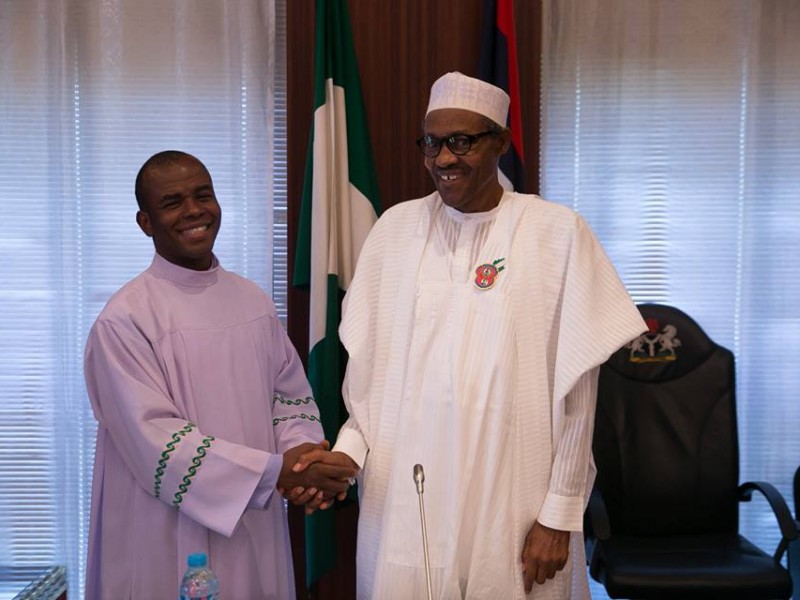
Father Mbaka Identifies Key Suspects in Plot to Kill Buhari


mbaka buhari
Adoration Ministry in Enugu, Nigeria led by Rev. Fr. Camillus Ejike Mbaka has identified those criticising the prophecy on a plot to assassinate President Muhammadu Buhari as the key suspects.
The ministry’s Media Chief, Mr Ike Maximus Ugwuoke who described the critics as “democratic miscreants” insist that they should be held responsible if anything happens to the President.
Ugwuoke said “Are they guilty or privy to the plot which the man of God had exposed? The laborious manner with which they attacked the prophetic message in an attempt to filibuster and water it down betrays their innocence on this issue and this should make them prime suspects in the list of the nation’s intelligence security surveillance.
“Section 38(1) respects universal right to freedom of religion and to manifest and propagate same either or in community with others in public or private just as it guarantees freedom of expression in Section 39.
“If the Constitution which gave every citizen of this country the right to worship did not prohibit him from declaring the message he receives from the God he worships, we then wonder why a priest of God and a citizen of this country should be threatened for exercising his constitutional right.
“A situation where the fundamental human rights which is the tenet of the ideals of democracy is bastardised by an acclaimed human rights group that is meant to protect same is indeed worrisome and makes mockery of the nomenclature.”
A human rights group had threatened to drag Fr Mbaka to the Pope, if the Catholic Bishops Conference of Nigeria failed to reproof him and stop him from actively associating with politician.
The ministry called on the human rights group to “withdraw that threat forthwith or face the legal consequence. We know of the utterances by many leaders of different churches at the beginning of this year who in exercise of their religious freedom predicted so many things such as plane crash, bank robbery, bank collapse, natural disasters etc, no one threatened to sanction them. The question is; why should Fr Mbaka’s prophecy always attract venomous criticism by some Nigerian, especially by the so-called Christians who will never talk about the manifest miracles of God through him and his consummate charitable life?
“Was the fulfillment of his prophecy of President Buhari’s victory last year which earned him and the ministry the highest media attack ever not yet enough lesson to Nigerians that Fr Mbaka is indeed a prophet of God and a gift to this nation?
“Last year when Fr Mbaka prophesied the defeat of former President Goodluck Jonathan, many Christian including notable clergymen branded him a false prophet and clamoured for his sanction. Now that the prophecy came true with Buhari’s victory, why shouldn’t the acclaimed sanctions be meted to those clergies whom the manifestation of Fr Mbaka’s prophecy has proved to be the real false prophets?
“No one seems to think about this. It is unfortunate that some men of God and so-called Christians either for lack of prayer points or out of chronic envy and jealously now make ‘Fr Mbaka’ the topic for exhortation in their gatherings. This also explains why the recent speculations on his transfer has taken the place of sermon in some churches and even made national news headline even when there is no official communication of such.
“We love our president and his life means much to us, especially at this point of the nations’ history when he is fighting the most dread wars in the world, the hydra-headed war against corruption and insurgency.
“Besides Fr Mbaka’s prophecy of the plans of the enemies against him, no good thinking citizen of this country would believe that the victims of Mr President’s war against corruption would be smiling at him. That is why we should not relent in praying for Mr President and will never spare any one or group of persons that may want to distract Fr Mbaka and his commitment to the spiritual welfare of this nation.”

2016 budget intact, not missing – N’Assembly


2016 budget intact, not ,issing – N’Assembly
The National Assembly yesterday debunked speculations that the 2016 budget was missing, and assured that the Senate and the House of Representatives are in the process of making copies of the money Bill available for the 109 senators and 360 members of the House.
The lawmakers added that they are determined to pass the bill as soon as possible.
Describing the speculations of a missing budget as laughable, the chairman of the Senate Committee on Media and Publicity, Senator Abdullahi Sabi, said the contents of the 2016 budget were carefully drafted to enhance and drive the change agenda of the present administration.
He added that the senators were eager to pass the budget so that implementation would commence immediately so as to deliver the dividends of democracy to the electorate.
The Senate spokesman said, “There is no such thing; it is laughable for anybody to insinuate that the 2016 budget is missing; it is the figment of the imagination of those carrying such rumour.
“We, as a Senate, are presently concentrating on making copies of the budget available to every senator. We are getting ready to commence deliberations on the budget and we are enthusiastic and looking forward to a quick passage so that the president would commence implementation in such a way that the electorate would begin to reap the dividends and benefits of democracy.

“So it is not true that the budget is missing; it is a rumour. We deal with facts here and the fact is that no budget is missing,” Senator Sabi declared.
President Muhammadu Buhari had submitted the 2016 budget to a joint session of the National Assembly on 22nd December, 2015.
Shortly after the presentation, the National Assembly proceeded on a three- week end of the year and Christmas break.
There were speculations yesterday that the 2016 budget was missing within the National Assembly.
In a related development, the leadership of the House has denied story of 2016 budget theft from the National Assembly doing the rounds, saying that original copy of the Appropriation Bill as presented to NASS was intact and with the management of the Assembly. The House also said that the reproduced copies of the budget will be distributed to members today ahead of the consideration of the estimates at the various committee levels beginning next week.
The spokesman of the House, Hon. Abdulrazak Namdas, who spoke last night through his deputy, Hon. Jonathan Gaza Gbefwi, said the rumour of budget theft or missing was unthinkable, wondering why it was fabricated in the first place.
“The budget is intact and, in fact, they even plan to begin to distribute copies to members tomorrow (today) to begin to analyse; so wherever that (rumour) is coming from, I don’t know. So, it’s all a lie,” he said.
Another source in the House said that the rumour of budget theft may not be unconnected with the alleged plans by the Presidency to retrieve the document in order make some corrections.
The source added that all the allegations remain ‘in the realm of rumour.’

Tuesday, 12 January 2016

Photo: Taraji P. Henson and Viola Davis cover Elle magazine

See the award-winning actresses as they covered the February issue of Elle magazine

Switzerland to return $300m looted funds to FG


President Muhammadu Buhari

The Minister of Foreign Affairs, Geoffrey Onyeama, has assured Nigerians that negotiations are ongoing with a number of countries on the modalities for the repatriation of some looted funds stashed abroad.
The minister stated that the Federal Government had been in touch with Switzerland, which he said, had earlier repatriated $700m to Nigeria. He noted that another $300m that was recovered would soon be repatriated to Nigeria.
Speaking in an interview with journalists in Abuja, Onyeama stated that the Federal Government was in discussion with the United Kingdom, the United States, among other foreign governments around the world, on how all looted funds could be recovered.
He said, “We are in touch with Switzerland; they have recently recovered quite a significant amount of money and I met last week with Swiss representatives to work out the modality for the repatriation of the funds.
“The Swiss government has already repatriated over $700m from (the late Gen. Sani) Abacha loot and that agreement has been reached on how the money would be applied.
“They have also now recovered in the same context another $300m of which there is ongoing discussion to have that repatriated as well. There are discussions with other countries; United Kingdom for instance, as you all know, is one of the countries we are discussing with on how to recover looted funds.
The minister explained that the goodwill generated by President Muhammadu Buhari’s visits to the US and other countries had helped in getting various nations to cooperate with Nigeria on the loot recovery drive.
Source: PUNCH.

Nwobodo joined APC through the window –Okechukwu


Jim Nwobodo

A chieftain of the All Progressives Congress in Enugu State, Mr. Osita Okechukwu, on Monday said the party should screen politicians that wished to defect from the Peoples Democratic Party to the APC before granting them membership.
Okechukwu said this while reacting to the defection of a former Minister of Information and ex-governor of the old Anambra State, Chief Jim Nwobodo, from the PDP to the APC last Friday.
Nwobodo was a senator and presidential aspirant on the platform of the PDP.
Expressing reservations about Nwobodo’s defection to the APC, Okechukwu noted that the elder statesman was linked to the arms deal scandal, involving the former National Security Adviser, Col. Sambo Dasuki (retd.).
Okechukwu, who pointed out that he was not opposed to new members joining the APC, said, “Political parties are like churches and mosques; they have open entry.
“However, there is the need to sieve the defectors.
“Is it not a paradox that those who are fingered in the Dasukigate scandal, people who rigged and mangled the 2015 general elections, are today wearing the badge of virtue and principle?”
Okechukwu added that some members of the APC in Enugu State, who were not happy with Nwobodo’s defection, were not worried about positions as insinuated by the former governor.
“We are not talking of position but pollution of our great party. He (Nwobodo) should first cleanse himself of the Dasukigate scandal.
“Don’t forget that the first cardinal programme of the APC is war against corruption; it is there in our manifesto,” he said.
Okechukwu alleged that Nwobodo used part of the money received from Dasuki to rig the 2015 elections in favour of the PDP in Enugu State.
He said Nwobodo entered the APC through the “window.”
According to him, Nwobodo has yet to register as an APC member at his ward.
“My take on his defection into our great party through the window is same with those who classified him as a fugitive of justice, given his involvement in the Dasukigate scandal.
“My investigation showed that up till date, he hasn’t registered in his ward; he was smuggled in by his allies and soul mates in our party, who connived with them in utilising the money from Dasukigate to allocate 14,175 votes to President (Muhammadu) Buhari, less than three per cent of the over 15,000,000 votes garnered by Mr President,” Okechukwu said.
He dismissed reports that the leadership of the APC in Enugu State had vowed to punish all those who opposed Nwobodo’s membership.
He accused the leadership of the APC in the state of deliberately turning the party into an arm of the PDP.
“Which leadership? Maybe those who not only squandered our campaign funds, but albeit are daily ignobly busy converting the APC Enugu State into a department of the PDP?
“Their imagination is that the recruitment of our elder brother and others will shield them from investigations,” Okechukwu said.
He accused Nwobodo of abandoning the principles which made him popular in the past.
Okechukwu added, “To be candid, Chief Nwobodo used to be our model: a principled politician and a Zikist. But in more than a decade, he has shed his principle and kind of descended into the arena.”
  
Source: PUNCH.

Monday, 11 January 2016

Headies Boss Ayo Animashaun Confirms Both Don Jazzy and Olamide have apologized to him


Executive producer of The Headies Awards and founder of Hip Tv, Ayo Animashaun while speaking recently about the controversy that played out at this year’s Headies confirmed that both Olamide and Don Jazzy have called him to apologize for their behaviour at the show.
“Olamide is like a son to me. What he did was to the Headies and not to me but he has apologised to me personally. He knows the right thing to do because The Headies is a platform that has celebrated a lot of artistes including him. He and Don Jazzy apologised to me the next day. As the executive producer of the award, I do not act unilaterally, I have a board and we have a disciplinary team and very soon, they will come up with a statement on how to handle the whole issue. We would make it public.”