Friday, 29 January 2016

Baby girl born ‘pregnant’


Report claims the baby girl had twins fetuses inside her when she was born According to the South China Morning Post, the baby was noticed to have had two tumors during a scanning process. It was later discovered that the tumors were fetuses of twin babies.
The baby which was allegedly born at Queen Elizabeth Hospital was said to have the fetuses at 10 weeks gestation and each had four limbs, a spine, rib cage, intestines and brain tissue as at the time it was born.
“It was almost impossible to detect during the prenatal check-up, as the embryo inside the baby was too small. Since it is impossible for the little girl to have conceived the pregnancy on her own, the fertilization of the twin fetuses, of course, belongs to her parents, which has gone to the wrong place,” Yu Kai-man, a former professor at Chinese University of Hong Kong, allegedly said.

Harrison Ford, Anthony Hopkins, Natalie Dormer join spy thriller 'Official Secrets'


Harrison Ford, Anthony Hopkins, Natalie Dormer, Paul Bettany, and Martin Freeman will star in the spy thriller Official Secrets, the Solution Entertainment Group announced Thursday.
Based on Marcia Mitchell’s nonfiction book The Spy Who Tried To Stop A War, the film is to recount the story of Katharine Gun, a British intelligence officer who leaked information to the press about an NSA spy operation allegedly intended to press the U.N. Security Council into sanctioning the Iraq invasion.
Dormer will portray Gun, Bettany and Freeman will play journalists at the London Observer, Hopkins will play a retired U.K. general, and Ford will portray a CIA agent.
Justin Chadwick (Mandela: Long Walk to Freedom, The Other Boleyn Girl) is directing from a script by Sara Bernstein and Gregory Bernstein. Elizabeth Fowler is producing, with Lisa Wilson and Myles Nestel executive producing.
Production is scheduled to start in the U.K. in May.

Culture shock in Nigeria 5 top strangest traditions


So shocking! Other cultures can be crazy even if those people live right next door to you. Read about it now!
Nigeria is a large country. Lots of different people live here. More than 200 ethnicities are found on its territory. Each of them has its own customs and traditions. Someone, who comes to the country for the first time will probably experience culture shock in Nigeria, because certain rituals might seem really unusual to the foreigners. However, it will be interesting to know about the most prominent of them. That’s why we're going to observe top strangest traditions.
Culture shock in Nigeria

Tribes and their peculiarities

As you already know, there are many ethnic groups in Nigeria. However, it's possible to distinguish three biggest ones. They are Igbo, Yoruba, and Hausa. To avoid culture shock in Nigeria, it's better to know about their main customs. Thus, before we start speaking about top strangest traditions, let’s observe each group:
Igbo. They comprise about 70% of southeastern population. Historically, they come from Nri Kingdom, which is the oldest in Nigeria. They have really great heritage and culture. From the ancient times they make bronze vessels for various ceremonies. As main other tribes, Igbos have their musical styles. The main instruments are opi, igba, and ichaka.
READ ALSO: Culture shock in Nigeria - Ijaw people throw their newborns right into the river! Is that right?
Culture shock in Nigeria Igbo.
One of the famous musical forms is called highlife. It is a mixture of jazz and traditional music, which has become very popular in West Africa. The most widespread crop for this tribe is yam. There are even lots of festivals, held to celebrate its harvesting. Igbo cuisine is very diverse. It includes different types of food. They prefer meat, fruit, and vegetables. It was also influenced by their history and environment. The common dishes are Egusi, Bitter leaf, and Okra soups.
Culture shock Igbo.
We can say that those people have their fashion. Their traditional clothes are very special. In fact, it's mostly used to cover private parts of body. Nevertheless, the elders are always fully dressed. According to the customs, children are nude from their birth till adolescence, because it is thought, they have nothing to hide yet.
Culture shock Body art
Body art is very popular among both men and women. In course of time, European style in clothing has started to prevail. Many people now wear shirts and trousers. Modern traditional attire for males includes Isiagu top (resembling African Dashiki and patterned with lions’ heads) and title holders hat or Igbo stripped men's hat. As for the females, they wear puffed sleeve blouses with two wrappers and a headscarf.
Yoruba. They are about 80% of the southwest and more than 20% of the whole population in the country. This ethnic group is spread throughout all West Africa as well. Historically, they are very prominent in art (like bronze sculpturing) and poetry. Their textile work is also striking. They apply various kinds of looms to create wonderful patterns. The most popular foods are pounded yam, Amala, eba, Moin moin, semo, fufu, and akara. Besides, they like different soups such as egusi, ewedu, and ila okra.
Culture shock in Nigeria Yoruba.
Yoruba people have adopted many Western traditions; however, they have also managed to preserve their own. For example, they have really interesting wedding traditions, which include stages of courtship, acquaintance with parents and family, payment for the bride, and so on. Wedding day is considered a day of celebrations, drinking and eating, dancing for parents, relatives, the newlyweds, their friends and sometimes even foes. For Yoruba people, it is unification of families, and not just two people.
Culture shock Yoruba.
Wedding rituals make them connected for all life. One of the weird wedding rituals is known as Ekun Iyawo (which means The cry of the new bride). The woman is accompanies by her family to her husband’s house in order to show, she is sad to leave her home. There, she is prayed for, and her legs are washed. They believe that by thus, she’s all the bad luck will vanish. You should also know, different subgroups of this tribe confess various religions. For instance, Christians often combine these ceremonies with the church ones.
Wedding rituals Yoruba.
Hausa. It is the largest Nigerian tribe. They comprise about 30% of total population of the country and 60% of the north. There exists another tribe, called Fulani. They have very similar traditions; that’s why all of them often referred to as Hausa-Fulani. Most of people of this ethnic group are Muslims, that’s why they follow Islamic traditions and have autocratic society. They are very prominent in art, especially in architecture.
Tubali
Their style, known as Tubali, is featured by dry mud bricks in cubic structures, multi-storied buildings, the application of parapets related to their military building past, and traditional white stucco and plaster for house fronts. The Hausa cuisine is also unique. It consists mostly of grains (such as millet, maize, rice, etc.). The most widespread dishes are kosai (cake made of beans) and funkaso (cake made of wheat flour and served with sugar). Various porridges and soups are famous as well.
 Hausa Babban riga
As for the clothing, they have very strict dress code. Men usually wear large flowing gown (Babban riga) and a robe, called jalabia. Besides, they have colorful caps known as hula. Women wear wrappers (zani), blouse, head tie, and shawl.

Unusual traditions

Now we can talk about the strangest Nigerian traditions. They are:
  1. Widowhood Practice. After the burial ceremony, the woman must show she is nothing without her husband. Besides, it is essential to display, she has no responsibility for his death. She is subjected to some kind of humiliation. For example, she might be made to drink the water, in which the corpse of her spouse has been washed. Her relatives may shave her hair and force her to sleep with the dead man.
    Culture shock Widowhood Practice.
     
  2. Sharo Festival. It's one of the strangest festivals. It is public ritual, which demonstrates to the rest of society that young man has come of age, and is ready to have a wife. A man is whipped by a challenger for several times. During the process, he must not show any signs of pain. It is a Fulani tradition, which attracts people of all ages and professions.
    Culture shock Sharo Festival.
     
  3. Inheritance Practices. There exists a belief that wife is a kind of property, which might be passed around. Thus, after the husband’s death, the wife might be inherited by one of his brothers. However, this tradition is slowly becoming an issue of the past.
    Inheritance Practices in Nigeria
     
  4. The Magun. All the Nigerian ethnic groups are strongly against adultery. Yoruba people has a strong black magic for such sinners. The Magun can be placed in a married girl without her even knowing about it. And if she commits adultery, her lover might die.
     Yoruba people has The Magun
     
  5. Circumcision. It is widely practiced in Nigeria and in whole Africa. For men, it is partial or complete removal of foreskin around the genitals, while for women it is removal of genitals. This ritual is meant to preserve the chastity of women.
    Circumcision in Nigeria
There are lots of unusual feasts, entertainment, and traditions. Nevertheless, most of them are the thing of certain ethnic groups, so they are not spread throughout Nigeria. However, it might be interesting to know about them, even if some customs seem scary.
 Nowadays, education has become more available for the people in different parts of the country. It gives an opportunity to stop the most strict and cruel traditions. However, it is vital to remember that there are plenty of nice and amazing ones. Such cultural things should be preserved by all means.

Man Explains How Bishop T.D Jakes Sermon Changed His Life

The person who changed my life is someone I had never even met

Bishop T.D. Jakes is a source of inspiration for millions but listening to his sermons, it feels as though he is speaking just to you.

If there's anything you should know about me it is that I'm not a conformist. Never have been, never will be. So it is fitting that the person who changed my life is someone I had never even met.
Let me explain.
Besides family members, there have only been a handful of people who have genuinely wanted to see me succeed. The ones who did have my best interests at heart were not always in the same city, let alone the same state to spend any real time with. So, for most of my adult life I've been pretty much a loner, sometimes by choice, but usually out of necessity.
It was during one of the more difficult periods of my life and career that the person who would change my life showed up, and in a big way.
I was living in Chicago in the early 2000s when everything I had worked for, everything I had dreamed of accomplishing, was in danger of being shattered because I had, once again, refused to conform.
I had been lured to Chicago from my network news job in New York with the promise of the big stories and the anchor chair. Instead I was sent out to cover shootings, stabbings and fires. When I dared to say no, to stick up for myself, I was publicly taken to task and very nearly fired. It was a low point in my life and career.
Back then it had been my habit to run daily along the lake in Chicago. Normally I ran to music. But with iPods and iTunes newly becoming prevalent, it became easier to replace the empty pulsating dance, pop or rap music with lectures or motivational speeches.
It wasn't, however, until one day by happenstance I downloaded a sermon entitled "You Don't Have To Believe In My Dream" from Bishop T.D. Jakes. That's when everything changed. And I mean everything!
While I was dealing with my work and life crisis, I would run every single day. As I logged mile after mile in heat waves, driving rain or snowstorms, I would listen to that same sermon on "dreams" over and over and over again.
The central tenet to Jakes' sermon was from the Bible, Romans 3:3-23, which reads, "For what if some did not believe? Shall their unbelief make the faith of God without effect? God forbid: yea, let God be true, but every man a liar."
People not believing in my dream had been a recurring reality in my life. So, it was as if Bishop Jakes was speaking directly to my circumstances and me when he told members of his congregation and everyone listening to turn to the person next to them and say, "Hey neighbor, you don't have to believe in my dream."
I would turn and shout it to whomever was running next to me or past me on the running path. And if I were alone I would shout it out loud. Within a very short amount of time, my attitude, my outlook and what I thought was important began to change. My life changed!
I no longer needed approval from anyone, including the people who I had once thought could control my career and what I wanted to accomplish. I realized that I was the only person who was in charge of that. It was liberating.
I know it sounds strange that the person who was a mentor only in my head had had so much of an impact on my life. But isn't it the person who has our ear often the person who influences us most?
Years later, long after I left Chicago and was working for CNN, I finally got the chance to interview Bishop Jakes, first by satellite and then in person. He had no idea of the impact he had on my life. He had no idea that, in large part, the reason I had achieved the success that I had was because of him. He had no idea that one of the main reasons I was sitting across from him at the anchor desk, was because of him.
He had no idea -- until now.
*If you need some inspiration and would like to hear a portion of the sermon that changed my life, here's a link.

Japan adopts negative interest rate in surprise move


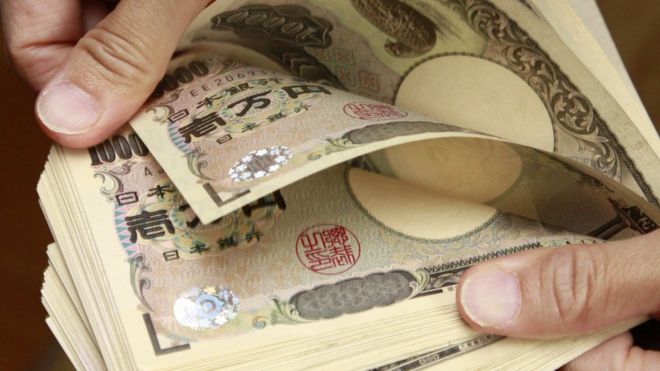
Yen notes

In a surprise move, the Bank of Japan has introduced a negative interest rate.
The benchmark rate of -0.1% means that the central bank will charge commercial banks 0.1% on some of their deposits.
It hopes this will encourage banks to lend, and counter the ongoing economic slump in the world's third-largest economy.
The European Central Bank also has negative rates, however, it is a first for Japan.
The decision came in a narrow 5-4 vote at the Bank of Japan's first meeting of the year on Friday.
"The BOJ will cut interest rates further into negative territory if judged as necessary," the Bank of Japan said, adding it would continue as long as needed to achieve an inflation target of 2%.
Some analysts have cast doubt over how effective the rate cut will be.

Why has Japan made this move?

  • Japan is currently facing very low inflation, which means that people and companies tend to hold on to their money on the assumption that they can get more for it later in time. So rather than spend or invest it, they will keep it in the bank.
  • Charging a percentage to keep money in the central bank might encourage commercial banks to lend it out. That would boost both domestic spending and business investment.
  • It is also aimed at driving inflation up, which is another incentive for people and businesses to spend rather than save.

In a press conference, the BOJ's governor Haruhiko Kuroda pointed at the global economic outlook when explaining the cut.
"Japan's economy continues to recover moderately and the underlying price trend is improving steadily," he said, but warned that "further falls in oil prices, uncertainty over emerging economies, including China, and global market instability could hurt business confidence and delay the eradication of people's deflationary mindset".
Earlier in the day, fresh economic data had again highlighted concerns over economic growth. The December core inflation rate was shown to be at 0.1% - far below the central bank target.
Asian shares jumped and the yen fell across the board in reaction to the announcement. Japanese banks though saw their shares drop on the news as lenders are likely to see their margins squeezed even more.


The decision to implement a negative interest rate has been dubbed "Kuroda bazooka" after the governor of the Bank of Japan.
Haruhiko Kuroda, is well known for making surprise moves that shock investors. Only a few weeks ago, Mr Kuroda told the parliament budget committee that he would not introduce more stimulus for the economy.
So today's announcement caused the stock market to jump while the yen fell sharply against major currencies.
The option of lowering the cost of borrowing below zero has been on the cards for Japan's central bank since the early 2000s and it was the first in the world to consider it.
But when it comes to implementing the policy, Denmark, Sweden and Switzerland were first, followed by the European Central Bank which had to do everything it could to keep the EU economy afloat after the eurozone economic crisis.

Last resort

There are doubts, however, over how well the new policy will work.
"Negative interest rates are one of the last instruments in the BOJ's tool box," Martin Schulz of the Fujitsu Institute in Tokyo told the BBC. "But their impact is unlikely to be strong."
Mr Schulz cautioned that in the eurozone, negative interest rates are being used to tackle a financial crisis, whereas Japan is in a protracted slow growth environment.
"In Japan, credit didn't expand not because banks were unwilling to lend but because businesses didn't see the investment perspective to borrow. Even with negative interest rates, this situation will not change."
"Businesses don't need money - they need investment opportunities. And that can only be achieved by structural reforms, not by monetary policy," he said.
The decision comes in addition to the BOJ's massive asset-buying programme, which over the past years had failed to boost growth.

Source: BBC

Mixed reactions as Buhari rejects naira devaluation


President Muhammadu Buhari

President Muhammadu Buhari has again rejected calls for the devaluation of the naira, saying he has yet to be convinced that the country and its people will derive any tangible benefit from such a move.
A statement by his Senior Special Assistant on Media and Publicity, Mallam Garba Shehu, on Thursday quoted the President as speaking at a meeting he had with Nigerians living in Kenya late on Wednesday.
Buhari, who is currently on a three-day state visit to Kenya, was said to have maintained that while export-driven economies could benefit from the devaluation of their currencies, such a move would only result in further inflation and hardship for the poor and middle class in Nigeria’s import-dependent economy.
The President said he had no intention of bringing further hardship on the country’s poor, who he noted had suffered enough already.
He likened further devaluation of the naira to having the currency “killed.”
Buhari added that proponents of devaluation must work harder to convince him that ordinary Nigerians would gain anything from it.
The President also rejected suggestions that the Central Bank of Nigeria should resume the sale of foreign exchange to Bureaux De Change, saying that the BDC business had become a scam and a drain on the economy.
“We had just 74 of the bureaux in 2005; now, they have grown to about 2,800,” he noted.
Buhari alleged that some bank and government officials used surrogates to run the BDCs and prosper at public expense by obtaining foreign exchange from the government at official rates and selling it at much higher rates.
“We will use our foreign exchange for industry, spare parts and the development of needed infrastructure. We don’t have the dollar to give to the BDCs. Let them go and get it from wherever they can, other than the central bank,” Buhari told the gathering.
The President reaffirmed his conviction that about a third of petroleum subsidy payments under the previous administration was bogus.
“They just stamped papers and collected our foreign exchange,” he stated.
Buhari appealed to Nigerians studying abroad to bear with his administration as it strives to address the challenges they were facing as a result of the new foreign exchange measures.
He said that he was optimistic that the Nigerian economy would stabilise soon with the efficient implementation of the measures and policies that had been introduced by his administration.
However, some economic and financial analysts have faulted Buhari’s position on the naira, stressing that the CBN would find it difficult to preserve the currency from further devaluation amid the depleting external reserves.
The Chief Executive Officer, Cowry Asset Management Limited, Mr. Johnson Ckukwu, said, “This position is not sustainable; the CBN will find it difficult to keep and preserve the naira in the face of falling forex income to the nation.
“We cannot continue like this as a country. Already, the CBN is no longer able to provide forex for basic raw materials and production inputs; this may lead to further factory closures. It is in our best interest to devalue now.”
Renowned economist and Chief Executive Officer, Financial Derivatives Company Limited, Mr. Bismarck Rewane, said a combination of naira devaluation and forex controls by the CBN would save the country.
He said the naira-dollar official exchange rate, pegged at between 197 and 199, was not realistic, adding that there was a need for further adjustment of the official exchange rate.
A professor of Economics at the Olabisi Onabanjo University, Sheriffdeen Tella, is, however, of the opinion that a further devaluation of the naira will not be in the interest of an import-dependent nation like Nigeria.
He said countries like China allowed official devaluation of their currencies because they had several products to be exported in order to earn forex.
Tella said while such a move could be good for export-oriented countries like China, it would be counterproductive for an import-dependent nation like Nigeria.
“Do we have the products to export abroad if we are to devalue the naira? Devaluation will, no doubt, make exports to be more competitive in the international market, but we don’t have the products to be exported for now. This is why devaluation may not be good for Nigeria at this moment. China will allow its currency to be devalued because it has the products to be exported,” he explained.
Chukwu, however, disagreed with Tella on this position, maintaining that devaluation of the currency was good for an import-dependent economy like Nigeria.
He said, “Actually, naira devaluation is good for the economy; it will not hurt an import-dependent economy like ours the way some people have perceived it. When we devalue the naira, it will make some imported goods to be so expensive that some local substitutes will begin to spring up; this will help to stimulate domestic production.
“Again, when we devalue, it makes our exports as a country to be cheaper such that they will become more competitive in the international market.”
Last year, the former Governor of CBN, Mallam Lamido Sanusi, said Nigeria needed to devalue the naira because the CBN might not be able to sustain its current forex control polices on the long run, especially in the face of the depleting forex earnings by the nation.
Another former CBN Governor, Prof. Chukwuma Soludo, in a paper presented at a forum last year, said history had shown that forex restriction had not worked in many countries in the past.
While the naira sells for 306 against the dollar at the parallel market currently, the CBN still keeps the official rate at between 197 and 199.
Economists said the widening gap between the official and parallel market rates would continue to breed all manner of sharp practices in the forex market.
  source: PUNCH.

According to Economist magazine, Goodluck Jonathan is an ineffectual buffoon

In an article titled 'Crude Tactics', Economist magazine described former president Jonathan as an ineffectual buffoon. The article reads in part;
"In the eight months since Mr Buhari arrived at Aso Rock, the presidential digs, the homicidal jihadists of Boko Haram have been pushed back into the bush along Nigeria’s borders. The government has cracked down on corruption, which had flourished under the previous president, Goodluck Jonathan, an ineffectual buffoon who let politicians and their cronies fill their pockets with impunity. Lai Mohammed, a minister, reckons that just 55 people stole $6.8 billion from the public purse over seven recent years."- Read the full article here

Thursday, 28 January 2016

GOtv to beam RedCarpet of Hollywood’s Award live 30 January


2016 Screen Actors Guild Awards
GOtv has announced that the red carpet of one of Hollywood’s most glamorous nights, the 2016 Screen Actors Guild Awards, will be shown live on its bouquet on Saturday, 30 January at 12am.
The RedCarpet on Channel E! will take viewers behind the scenes of the event, reporting live with all the latest gossip and fashion updates, as the stars hit the red carpet in their finery to celebrate outstanding work in film and television.
Channel E! will capture every fascinating moment, including exclusive interviews and expert predictions for the night ahead.
Meanwhile, GOgetters who love to watch series on Telemundo, are also advised to look out for what happens to Genaro in For Love and Justice as the series gets hotter.
For Love and Justice, shown weekdays at 5pm and its Finale on Friday 22 January, Diablo and Genaro are looking for Liliana in every hideout they can think of. Fernanda must stop the kids before they discover where Liliana is hiding. Lucia is also curious, but then Liliana threatens her with a gun.
El Diablo and his men attack a police control post and flee to Austin, Texas. Liliana is finally defeated, but Fernanda is in a bad way. It is Marisela and Rodriguez’s wedding day. Diablo sets a trap for Daniel. Lucia goes to the place where Daniel is being held prisoner. The confrontation between Diablo and Liliana results in Genaro getting shot.
Other captivating programmes this week include Shabri on Zee World, Deadly Instincts: Fear Factor and The Amazing Spider House on NatGeo Wild, among others.
Zee World is on GOtv Plus Channel 25.. Shabri takes matters into her hands after her brother is killed by corrupt police officers. She seeks revenge on the police and the gangsters that were involved.
The Amazing Spider House on NatGeo Wild, Friday 22 January at 6:30pm sees a team of experts fill a normal house with hundreds of spiders, and soon an astonishing drama unfolds within its walls, she said.

Sodomy: Prof., 3 others arraigned for Criminal Conspiracy


CourtThe Police in Kano on Thursday, arraigned the proprietor of Hassan Gwarzo College in Kano, Prof. Ibrahim Ayagi and three others over a sodomy scandal that had rocked the College recently.
The arraignment followed the investigation ordered by the Kano state government which was handled by a high powered Commission.
Ayagi and three others were arraigned on eight count charges which bordered on criminal conspiracy, negligence, failure to provide information and joint action among others.
In his submission, counsel to the accused, Barrister Abdulrazak Bagwai, had told the court that he was vehemently opposed to the arraignment of his client against the earlier date fixed by the court.
According to him, his clients were subjected to ill treatment by the police detectives in Kano despite the fact that the court had restrained the police from further arresting them since they were granted bail.
However, Police Prosecution counsel, Barrister S. O. Akwe said there was never a time the accused persons were shabbily treated or unilaterally arrested.
He said bringing the matter to the court against the date fixed (Feb.29) was not meant for further deliberation on the matter.
He stressed that it was to draw the attention of the court that an additional charge had been slammed against the first accused; who is the proprietor of the College.
The presiding judge, Chief Magistrate Aminu Kabara maintained that the Feb. 29, date fixed for the continuation of hearing the case remained intact.
NAN recalled that the accused were first arraigned before the court on Tuesday, but the presiding judge Aminu Kabara adjourned the case to February 21 for the prosecutors to carry out further investigation on the matter.

How Nigerian cult group traffics women into Europe – Spanish police


The Spanish police have raised the alarm about a Nigerian cult group, Supreme Eiye Confraternity, which is running a human trafficking racket and using British airports including Gatwick as entry points to traffic Nigerian women into Europe.
The Head of anti-trafficking at Catalonia police, Xavier Cortes, stated in an interview with British Broadcasting Corporation that the Nigerian cult gang had been “using forged documents and passports to fly its Nigerian victims into places like Gatwick.”
Cortes, who noted that members of the Nigerian cult group speak English language, said their choice of British airports to traffic prostitutes to Europe may be an indication that they were getting official help from Nigeria to obtain passports.
“These (fake) documents are expensive, though, and need co-operation of people working in the government to get,” Cortes was quoted as saying on the BBC‘s website.
The BBC, in a report, quoted the Spanish police as indicating that Supreme Eiye Confraternity had now resorted to using UK as opposed to crossing the Mediterranean Sea, which it had reportedly found to be deadly.
It quoted an unnamed Crime Squad Officer in Barcelona as saying that his team had bust a notorious Nigerian crime organisation running a network of trafficked prostitutes across the city.
Most of the women being trafficked by Supreme Eiye Confraternity are said to from Nigerian towns and cities, including Benin City.
According to the BBC report, the gang usually lured their victims with the promise that they would make money through prostitution and they usually had no idea of the pain that they would be subjected to.
One of such women, whose name was not given, had told the BBC that, “I did not know I would be beaten and raped and have to have sex every night of the week.”
Another woman, speaking after she was freed by a recent Spanish police raid in Barcelona, said she had been hit over the head with a glass bottle after telling a gang member she could not meet his demand for payment.
“I had scars all over my body,” she told the BBC.
According to the report, a recent raid on the Supreme Eiye Confraternity in Barcelona took 18 months of planning and resulted in 23 arrests.
“But the SEC has hundreds of members running operations out of Ibadan, about 100 km (60 miles) northeast of the Nigerian city of Lagos,” the BBC report said.
“In 2014, 70 per cent of nearly 900 Nigerian citizens applying for asylum in Britain had their applications refused, government data shows.
“Nigeria’s government has failed to comply with minimum standards for the elimination of human trafficking, though it has made some progress, the UK Home Office (interior ministry) said in a report on the country last year.
“More than 3,770 migrants and asylum seekers died in 2015 trying to reach Europe by crossing the Mediterranean Sea,” the BBC stated in the report.
The Civil Aviation Authority reported that in 2014 over 240 million passengers passed through UK airports.
The surge in arrivals has heaped pressure on European police and authorities to break a network of organised crime spanning the continent.
The UK’s National Crime Agency reportedly said last year that number of people identified as potential victims of human trafficking in Britain rose by 21 per cent to 3,309 in 2014.
The nationality of the victims was known in only 2,100 cases of which nearly 9 per cent were Nigerian, the agency’s data showed.

Metuh released from prison


Metuh released from prison
The spokesman of the Peoples Democratic Party (PDP), Chief Olisa Metuh, was on Thursday evening released from Kuje prison after perfecting the bail conditions handed down by courts in Abuja.
Justice Okon Abang of the Federal High Court, Abuja, on January 19 granted Metuh bail in the sum of N400m, and two sureties with landed property in the Federal Capital Territory.
He is standing trial for his alleged involvement in the diversion of arms procurement funds after receiving N400million from the Office of the National Security Adviser in 2014. .
The PDP spokesman was released from prison after Justice Abang signed his release warrant.
The judge, according to reports, signed the release warrant, after receiving details of the two sureties and other requirements provided by Metuh.

Source: The Nation

Zika virus spreading explosively – WHO


photo source: livescience.com
5121
The Zika virus is “spreading explosively” in the Americas and the region may see up to four million cases of the disease strongly suspected of causing birth defects, the World Health Organisation said Thursday.
As the number of suspected cases of microcephaly – thought to be linked to the virus – surged in Brazil, WHO head Margaret Chan said an emergency committee would meet on Monday to determine whether the Zika outbreak amounts to a global health emergency and how the world should respond.
Microcephaly causes babies to be born with an abnormally small head.
Cases have soared in Brazil from 163 a year on average to more than 3,718 suspected cases since the outbreak, and 68 babies have died, according to the health ministry.
Colombia, Ecuador, El Salvador, Jamaica and Puerto Rico have warned women to avoid getting pregnant for the time being, while France has urged women not to travel to French overseas territories in South America and the Caribbean.
Chan told an assembly of WHO member-states in Geneva that the severity of the current outbreak was unprecedented in recent decades.
For decades after Zika was first discovered in Uganda in 1947 the mosquito-borne virus was of little concern, sporadically causing “mild” illness in human populations.
“The situation today is dramatically different. The level of alarm is extremely high,” she said, with Zika also possibly linked to a neurological disorder called Guillain-Barre syndrome.
“A causal relationship between Zika virus infection and birth malformations and neurological syndromes has not yet been established, but is strongly suspected,” Chan said.
She told WHO members that the virus “is now spreading explosively,” in the Americas, where 23 countries and territories have reported cases.
Marcos Espinal, the head of communicable diseases and health analysis at WHO’s Americas office, said the region could see between three to four million cases of Zika.
That projection applied to the next 12 months and was based largely on historical spread patterns of similar mosquito-borne diseases like dengue fever, said Sylvain Aldighieri, a WHO epidemic expert in the Americas.
WHO has previously said that it expects Zika to spread to every country in the Americas except Canada and Chile.
There have not yet been any cases of local transmission of Zika virus within the United States, although infected travellers have returned to the country after visiting other areas.
However, a recent study in The Lancet suggests that Zika virus could reach regions of the United States in which 60 percent of the population lives, or some 200 million Americans.
Chan explained that the February 1 emergency committee meeting will also aim to identify priority areas for urgent research, after US President Barack Obama called for swift action, including better diagnostic tests as well as the development of vaccines and treatments.
Brazil has been the country hardest hit so far, and concerns are growing about this summer’s Olympic games, which are likely to attract hundreds of thousands of visitors to host city Rio de Janeiro in August.
Six months from the opening ceremony, the government has promised to attack mosquito breeding sites and protect visitors from the virus, from which there is no known prevention method aside from avoiding mosquito bites.
WHO’s deputy chief Bruce Aylward told reporters that it was “very, very unlikely” the UN agency would issue warnings against travel to Brazil, including for the games.
The head of the International Olympic Committee, Thomas Bach, said it will “do everything” in its power to keep the Games safe from the virus.
Honduras also said it had registered 1,000 cases of Zika, which is transmitted by the Aedes aegypti mosquito, the species that also carries dengue, chikungunya and yellow fever.
With concern over travel to Latin America spreading, two airlines in the region announced refund offers to pregnant women booked for travel.
Chilean-Brazilian airline Latam, the region’s biggest, will refund or rebook expectant mothers with tickets to any of 22 countries or territories with outbreaks of the mosquito-borne virus, while Chilean company Sky will refund pregnant women with tickets to Brazil.
US carriers Delta and American Airlines have made similar offers.
The Zika virus takes its name from a Ugandan forest, where it was first discovered.
Chan stressed that previous beliefs about the disease have been challenged by the fresh outbreak and that WHO needed better information as quickly as possible.
“The level of concern is high, as is the level of uncertainty. Questions abound,” she said. “We need to get some answers quickly.”

Man arrested for attempting to rape pregnant woman


Samuel Onochie

The Lagos State Police Command has arrested a diploma holder, Samuel Onochie, for allegedly sexually assaulting a pregnant woman, Esther (pseudonym), in Jakande, in the Eti-Osa Local Government Area of the state.
It was learnt that the woman, said to be eight-month-old pregnant, was passing through the area on Sunday at about 6am, when Onochie ambushed her.
The 34-year-old suspect, who told the police that he bagged a diploma in law from a university in Benin, Edo State, reportedly threw Esther on the floor and stripped her wrapper.
Our correspondent gathered that he had dipped his finger into Esther’s private parts and was about to penetrate her when a man was drawn to the scene by the woman’s wailing.
The man was said to have held Onochie, who is also a cobbler, while Esther rushed to the Ilasan Police Division and reported the incident, leading to his arrest.
A police source told our correspondent that the suspect had yet to explain why he allegedly committed the act.
“It is very disturbing that a man could commit such an act, especially with a pregnant woman. As if it was not enough, he did it in broad daylight. He has not been able to tell us why he committed the act,” the source said.
Onochie was brought before a Tinubu Magistrate’s Court on Wednesday on one count of sexual assault by a police prosecutor, Inspector Philip Osijale.
The charge read, “That you, Samuel Onochie, 34, on January 24, 2016, at about 6am, at Jakande, Lekki, in the Eti-Osa Local Government Area, within the Lagos Magisterial District, did sexually assault one Esther, by inserting your finger into her private parts, thereby committing an offence contrary to and punishable under Section 259 of the Criminal Law of Lagos State, Nigeria, 2011.”
The defendant pleaded not guilty to the charge and elected summary trial before the presiding magistrate, Mr. L.A. Owolabi.
Owolabi granted him bail in the sum of N100,000 with two sureties in like sum.
The magistrate said one of the sureties must be related by blood to the defendant, adding that both sureties must have paid three years tax to the Lagos State Government.
While adjourning the case till March 14, 2016, Owolabi ordered that the defendant should be remanded in prison pending the time he would perfect his bail conditions.
He told the prosecutor to send the case file to the Directorate of Public Prosecutions for legal advice.
SOURCE: PUNCH.

Check out Cristiano Ronaldo's new N65bn Hotel


Apartment in Trump Tower


In an interview in December, three-time FIFA Ballon D’Or winner, Cristiano Ronaldo said he would take a clean break from football and live like a king.
He specifically said he would not be going into coaching or scheming to become the president of any football club.
Well, the Portuguese star may have started building his ‘estate’ to ensure he really gets to enjoy the life he envisioned for himself.
The 31-year-old, who said he may not retire from the game until he’s 35 or 40, has acquired a luxury hotel in the “most exclusive area” of Monte Carlo for a whopping £105 million (app. N65.5 billion).
The deal was believed to have been brokered with the collaboration of American presidential hopeful Donald Trump and an Italian real estate agent, Spanish sport paper MARCA reported.
The deal was reportedly completed last week.
Ronaldo has been known to collaborate with the billionaire Trump on other investment ventures, with a purchase of a £13 million-worth apartment in Trump Tower, New York in August 2015 readily coming to mind.

Source: The Herald

Wednesday, 27 January 2016

Music: Rihanna drops 'Work,' featuring Drake amid Anti release rumors


Good morning from Rihanna. The singer released a brand new single from her forthcoming album Anti early Wednesday, amid rumors that her long-anticipated record could arrive soon. The track, called “Work,” features Drake and debuted on Tidal before appearing on iTunes.
The release comes after Billboard published reports that Rihanna would drop a new song on Wednesday at 8 a.m. ET and that Anti would debut Friday. Fans have been waiting three years for the collection, which was originally due out last year following RiRi’s “American Oxygen” and her collaboration with Kanye West and Paul McCartney, “FourFiveSeconds.”
Last year, Rihanna also released “Bitch Better Have My Money” and its brutal, epic music video. In the final months of the year she teased an album name and art, debuting both at a gallery exhibit in Los Angeles in October.
Anti may not have a firm, official release date just yet, but the Anti world tour is set to begin in February.

Tuesday, 26 January 2016

Biafra: Some questions the would-be-Biafra-leaders need to answer


One may begin to wonder the reason for the agitation of the Republic of Biafra. It is only natural that a people will crave have freedom and become independent from the body which they no longer feel aligned with.
                In Spain, for some reason, a part known as the Catalonia have over the years demonstrated for a referendum to be an independent state. And in Sudan, South Sudan became independent in July 2011, having felt oppressed and marginalized by the North. The case of Sudan may well appeal to the situation of Nigeria. South Sudan had claimed that the North took over power and controlled the state after their independence from Western colonial masters, even though the oil in the South was the primary resource of the country.
                However, South Sudan has had no peace since its independence from Sudan. In this line, it brings to focus questions the ‘would-be-Biafra-leaders’ need to address in their bid to secede from Nigeria.
To begin with, South-east is one of the difficult, if not the most difficult, places to live in Nigeria – by difficult, I mean expensive, demanding and unfavourable for the poor, and so are the parts of South-south states that are included in the prospective map of Biafra. Should Biafra succeed in seceding from Nigeria, will the country be too expensive and difficult for its average citizens? This is one issue Biafra agitators should address.
Again, Nigeria is considered by many as a very corrupt and insecure country – it is defined in many negative terms. The question is if Biafra can be better than Nigeria. Nigeria is also a country with a high unemployment rate and South-east does not boast of much employable companies. That leaves one wondering if Biafra will be worse than Nigeria in the field of employment should they become an independent state.
South-east tertiary institutions are not better than other top tertiary institutions in other parts of Nigeria. Should the region become a republic of Biafra, will education be a worse nightmare than what we currently have in Nigeria?
My proposition is for South-east government to begin a process of building superpowers, industries, and making their institutions something to write home about if they actually have strong dream of becoming a republic of Biafra. South-east should be start now to be better than other regions in the country. United States is on top of the world today because they came off the back of a country that dominated the world. It will be an underachievement for the republic of Biafra if it were to secede from Nigeria and still be either the same or worse than Nigeria.

Why you shouldn’t shave your pubic hair


When it comes to personal hygiene, one major aspect that has been trailed by diverse reactions is the issue of keeping or doing away with pubic hair, the hair that grows in the frontal genital area of humans, located on and around the sex organs of both male and female.
To some, nothing else nauseates like seeing hair in their partner’s private part, while some people are delighted by it as the sight of it is even a major turn-on for them, and to some others, it really does not matter whether the hair is kept intact or not.
To Mr. Johnson Agbede, a lecturer in his mid 50s, there are a few other things that are as disgusting as seeing a hairy private part. “You know how it feels when you see thick (sometimes coloured) hair in someone’s armpit? That is the way I feel when I imagine anyone keeping his or her pubic hair. My wife knows and she dares not keep it. I don’t keep mine too and I make sure I shave every Saturday,” he added.
Agbede, who is a father of three, said he believes the hair should never be allowed to grow because, according to him, it tends to harbour dirt and cause body odour over time. “Keeping it just does not make sense. For what purpose?” he queried.
But just as much as Agbede despises pubic hair, Mrs. Taiwo Peters, a business woman and mother of two, says she sees nothing wrong with keeping the hair in that region “as long as it is kept clean.” Perhaps, her stance is also informed by her husband’s preference for keeping it intact.
“My husband tells me that seeing it turns him on and that the moment I shave it, I would be on my own. I could trim it mildly but not absolute removal. For him too, he doesn’t shave but he could trim it when it is becoming too bushy.”
Interestingly, those who support it say getting rid of the hair makes them feel clean and fresh while those against it say it does not allow for friction during sex and that leaving it is not harmful in any way. Thus, the argument keeps going back and forth. Findings however revealed that most people shave their pubic hair and their reasons differ.
Notably, the methods people use to get rid of the pubic hair include shaving (with the use of razor, clipper or scissors), creaming and waxing, which is a form of semi-permanent hair removal which removes the hair from the root before new hair starts to grow back in the area between four and six weeks.
But according to some experts, pubic hair should not be shaved; rather, it should be left as it grows because of the roles it plays as a cover that shields the organs from avoidable infections and friction. They noted that shaving could open up the skin for pathogens bacteria and viruses, thereby increasing the spread of sexually transmitted infections, skin irritation and other skin infections, like Molluscum contagiosum.
In addition, they said the removal of the hair could increase the risk of genital skin infections because small cuts or scratches occasioned by the removal of the hair could open the door for viruses to cause infections.
Even though the situation applies to both men and women, a study published on the American Journal of Obstetrics and Gynaecology found that about 60 per cent of women who shave their pubic hair were found to have at least one health complication, and the most common health challenges found were epidermal abrasion (a wound caused by superficial damage to the skin) and ingrown hairs.
The study revealed further that women who are obese are almost twice as likely to report a complication and almost three times as likely if they have total hair removal.
A consultant gynaecologist, Hugh Byrne, told United Kingdom Telegraph that the removal of pubic hair could lead to abscess, a swollen area within body tissue containing an accumulation of pus. He explained that an increase in abscesses as reported had been caused by bacteria that enter the body through the hair follicle that was left open. He however said the solution to such infection could be through the use of antibiotics or an operation.
According to a review of some studies on Journal of American Medical Association, published on Mail Online, the act of removing pubic hair could cause a deficit in the mucous membrane of the skin, which could allow viruses or bacteria to enter the body.
“Waxing causes deficit in the mucocutaneous barrier that may be sufficient for viral entry and transmission, potentially increasing the risk of acquiring STIs,” the report said.
The report added that waxing as a form of removing pubic hair does not only increase the risk of contracting STI, it also causes small injuries to the skin, the underlying structures, micro tearing of muscle fibres, the sheath around the muscle and the connective tissue. This in turn could lead to spread of infection, burns, bumps that form under the surface of the skin and folliculitis, which is an inflammation of the hair follicles.
It noted, “Pubic hair waxing can also cause burns, with most being superficial or partial-thickness burns, while bacteria including staphylococcus aureus, streptococcus pyogenes and pseudomonas aeruginosa were found to be among the infections people are at risk of contracting. They can be transmitted via contaminated waxing tools or from the person performing the procedure.
“Individuals who wax their pubic hair should be informed of this possible risk and perhaps be advised to abstain from sexual activity for a certain period of time after waxing.”
A gynaecologist, Dr. Olanrewaju Ekujumi, told Saturday PUNCH that when one shaves newly, the risk of transmitting skin infections to each other is high during sexual intercourse.
He said, “When you shave, there tends to be opening where the hair has been removed, it could be an avenue for organisms to penetrate and cause infections. So, when you shave, maybe you should avoid sex, even though it has also not been medically proven, theoretically, it is a possibility.”
Ekujumi explained further that even though some people feel very happy and comfortable when everything is nicely shaved, leaving the pubic hair unshaved has no negative effect on the body. He noted that the hair itself is a protective covering, such that before anything gets into the body through those areas, it would have overcome the hair first.
“In gynaecology, shaving has no medical implication, apart from the bumps and other things that could come with shaving or waxing. However, when someone shaves and the partner does not, if the person who shaves has coarse hair, it could irritate the person who does not shave,” he said.
When asked whether it is advisable to shave or not, he said it depends on what individuals want, but that instead of shaving, people could use scissors to trim the hair so as not to open up the skin.
According to a dermatologist, Dr. Funmilayo Ajose, there is no problem shaving or not shaving, but she suggested that those who wish to shave should do it correctly to avoid infections. However, she said people who have rashes when they shave their beards or legs should not venture into shaving pubic hair. Reason? She said rashes also tend to come up there and that it could be multiplied in the pubic area because the place is warm and germs and bacteria could rapidly multiply there.
She continued, “Some people’s pubic hair can be so strong that it can cause friction for their partner. So, it should be done in a way that it would not be prone to infection or irritation and ensure it does not have a sharp end that could make it a problem instead of being a solution. If in the process of shaving, the hair curls back and pricks the skin, it could introduce the germs that are outside the skin into the skin.
“However, there are non-irritant shaving chemicals that can remove the hair smoothly, but there is no harm leaving it and there is no harm shaving it.”
She explained that leaving the pubic hair does not lead to odour and shaving it does not reduce it, saying it depends on people’s personal hygiene.

 Source: PUNCH.

Ryan Giggs takes over Manchester United’s training


Ryan Giggs (right) will take charge of training on Monday after Van Gaal cancelled Sunday's session
Manchester United training was cancelled on Sunday and Ryan Giggs is taking the reins on Monday after Louis van Gaal flew home to Holland.
The manager’s future at the club became extremely bleak after the defeat by Southampton at Old Trafford on Saturday.
Van Gaal sounded like a beaten man on Saturday before jetting off, telling players and staff not to travel to Carrington for their standard running drills the day after a game.
The 64-year-old is in Holland for his daughter’s birthday and, while it cannot be helped, the timing is inauspicious.

Monday, 25 January 2016

Lassa fever: Lagos officials kill 7,243 rats in markets


Lassa virus is transmitted to humans from contact with food or household items contaminated with the excreta or urine of infected multimammate rats

The Lagos State chapter of the Environmental Health Officers Association of Nigeria on Monday said it had killed no fewer than 7,243 rats in eight major markets in the state under its ‘De-rat Market’ programme.
This came as the state government called on the health officers to intensify safety awareness campaigns across the state.
Speaking at a workshop on Lassa fever, which was organised by the ministry of Local Government and Community Affairs, the health workers association’s President, Samuel Akingbehin, said the 7,243 rats were killed at the Onigongbo, Oshodi, Oke-Odo, Ikotun Idanwo, Ojuwoye and Mile 12 and Alaba Rago markets.
Akingbehin said de-rating the markets was part of the association’s efforts to curb the spread of Lassa fever in the state.
“The exercise is strategic in our effort toward the prevention of Lass fever. We call on other agencies in the state to de-rat markets and stop Lassa fever.”
Akingbehin appealed to traders across the state to understand the efforts of the association to rid the markets of rats and rodents.
He said the plan was to de-rat markets in one local government area per day, starting from 5pm.
Akingbehin said, “We decided to put the exercise in the evening due to the nocturnal nature of rodents and our members had recorded successes in the markets visited till date.
“It took us about three hours to cover the Oshodi Market when our members went there for the exercise. Today, Monday, we will be visiting Suru-Alaba Market in Orile with about 400 EHOs to de-rat it.”
The Commissioner for Local Government and Community Affairs, Muslim Folami appealed to the health workers to go to the nook and cranny of the state to sensitise the residents.