Sunday, 28 February 2016

Breaking the Limit of Poverty - Stanley Chuck


Based on the Message of Bishop David Abioye


Stanley Chuck
Be reminded of the covenant; it is the highest level of relationship to keep. Covenant mandates you to keep to your word; promises may fail, but a covenant does not; circumstances may cause a promise to break, but God is not a covenant breaker.
            God’s prosperity is superior to man’s prosperity; God’s blessing is not limited like man’s, and it is sorrow-free. We read in the scripture that, the blessing of the Lord makes one rich, And He adds no sorrow with it – Proverbs 10:22.
            I like you to know that this is important because we have to know the source of true prosperity. Man can make you rich but not richer than himself; man’s blessing is limited but God’s is endless and sorrow-free.
            Poverty limits people, even socially. There is a class you cannot access if you are poor, no matter how anointed you are. The greatest freedom a man can attend is economic freedom; the black nations have no vote at the UN because of economic backwardness. No man ever has undivided respect in his home without first, gaining financial freedom. You need to be economically strong to determine where to live. I do not say these things to you to make you feel bad; I tell you raw facts and reality.

            Now to break the limit of poverty, you must begin with vision. God’s blessing to man is not always God-determined; it is vision-determined. It is vision that determines the measure of your prosperity; God makes provision but vision determines the allocation; God’s provision is provided for all, but a man’s vision determines his allocation; God is inexhaustible and unlimited but it is the vision of a man that limits the man.
            A few scripture reference will tell you how it is you that determines your provision. Heaven belongs to God but he has given man the heart to possess – He says to Abram, Lift up your eyes and look from the place where you are – northward, southward, eastward, and westward; for all the land which you see, I give to you and your descendants forever. Genesis 13:14-15. Now I like you to know that you cannot go ahead until you see ahead; vision is a motivator; what you can’t see, you can’t pursue. In verse 15, God will not give you everything he has; he only gives you what you can see from all he has, so your journey into greatness begins with your vision. Not often what you studied in school that determines where you are but what you can see. Your salary is not the end of your vision; God’s blessing is on daily basis; it says: give us this day our daily bread. Though a man’s salary is the reward of his labour, but God’s blessing is a daily favour.
            God said to Jeremiah, you have seen well. Be conscious of the fact that God is always excited by your vision; your vision is your meeting point with God; His word is delayed by your vision; he starts working with your vision. There is always a better place than where you are; vision is seeing beyond the immediate. Thank God for where you are but see beyond the immediate; see beyond your salary; you are limiting yourself by settling with the status quo.
            When you lack vision, you always settle with and worry about the unimportant issues of life. Your car engine knocks down, and your heart knocks down as well because you are thinking of where to get the money to fix it. We are restless and worry about most things in life because we always do not see ahead of us. Only what you see is what God will give you.
            Vision motivates superiority mentality; begin to imagine a future in prosperity; it is a process of bringing tomorrow into reality. With vision, your actuality is born because; it is with your mentality, another word for vision that determines your actuality.
            Poverty is a spirit and what it does is to hold down the mentality of its victims; it makes one think inferior; makes you think like a beggar and borrower. This spirit has affected the black man of our time. The spirit of poverty is the spirit of inferiority; the spirit of prosperity is the spirit of superiority. That was the spirit that worked in Abraham, that when king Melchezedek offered him gifts, he refused.
            The spirit of poverty always makes you think of what to get and not what to give; whom to get from and not whom to give.
Saturday, 27 February 2016

Read how UN peacekeeping soldiers rape 14-year-old girls in Central Africa Republic

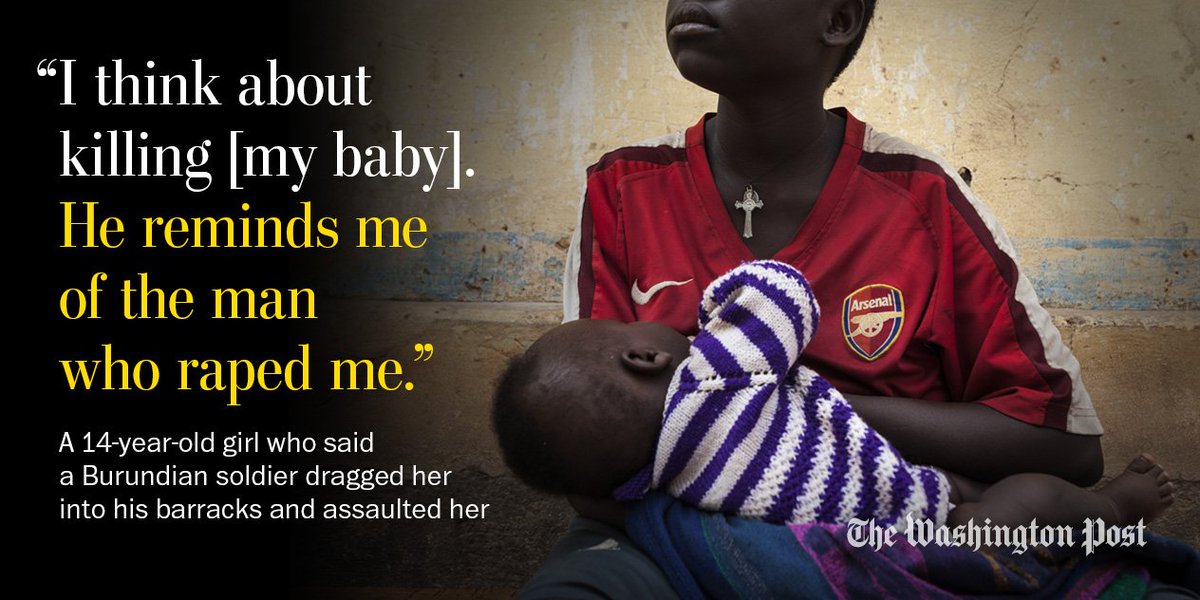
‘Sometimes when I’m alone with my baby,
I think about killing him.
He reminds me of the man who raped me.’

Members of a U.N. peacekeeping force in the Central African Republic allegedly turned to sexual predation, betraying their duty to protect


In Bangui, Central African Republic
Above:
A 14-year-old breast-feeds her 3-month-old son in Bangui, Central African Republic. She says she was raped and made pregnant by a U.N. peacekeeper from Burundi.

The neighborhood is a patchwork of low-slung buildings scorched and looted at the height of the civil war, a place where the United Nations was supposed to come to the rescue. But in a number of homes, women and girls are raising babies they say are the children of U.N. troops who abused or exploited them.
“Peacekeeper babies,” the United Nations calls such infants.

“A horrible thing,” says an elfin 14-year-old girl, who describes how a Burundian soldier dragged her into his barracks and raped her, leaving her pregnant with the baby boy she now cradles uncomfortably.
The allegations come amid one of the biggest scandals to plague the United Nations in years. Since the U.N. peacekeeping mission here began in 2014, its employees have been formally accused of sexually abusing or exploiting 42 local civilians, most of them underage girls.
U.N. Secretary General Ban Ki-moon has called sexual abuse by peacekeepers “a cancer in our system.” In August, the top U.N. official here was fired for failing to take enough action on abuse cases. Nearly 1,000 troops whose units have been tied to abuses have been expelled, or will be soon. Among them is the entire contingent from the Democratic Republic of the Congo.
But the victims appear to be more numerous than the United Nations has reported so far. In a corner of the capital city known as Castors, near the U.N. headquarters in the country, The Washington Post interviewed seven women and girls who described contact with peacekeepers that violated U.N. regulations against sexual exploitation and abuse. Five of them said they exchanged sex for food or money — sometimes as little as $4 — while their country was rocked by civil war and families were going hungry. Only two had reported their cases to the United Nations.
Five of the seven interviewed by The Post said they had borne the children of their abusers. The 14-year-old mother said she was assaulted by a Burundian soldier, but the United Nations recorded her case not as rape but as “transactional” sex, in which acts are exchanged for money or food.
“Sometimes when I’m alone with my baby, I think about killing him,” the teen said, holding the little boy. “He reminds me of the man who raped me.”

There has been only one criminal charge filed in the 42 cases of sexual abuse or exploitation that have been officially registered in the Central African Republic, according to U.N. officials.
The accounts by the women and girls could not be independently verified. But their stories are consistent with other accounts of abuse in the Central African Republic collected by independent groups and the United Nations.
The Washington Post does not identify minors who are alleged victims of sexual abuse or exploitation.
The U.N. system responsible for handling and prosecuting such cases has been widely criticized as dysfunctional, even after scandals involving peacekeepers in other parts of the world. Only one criminal charge has been filed in relation to any of the 42 cases of sexual abuse or exploitation that have been officially registered in the Central African Republic, according to U.N. officials.
U.N. officials did file a report on the 14-year-old mother’s case, and a U.N. spokeswoman, Ismini Palla, said the organization was “monitoring the case of the girl closely.” But nine months after the girl reported the alleged rape, investigators have not reported any results. U.N. officials had no comment on why they had classified the case as exploitation rather than assault.
Above: In the Castors area of Bangui, the capital of the Central African Republic, the six women and girls pictured here spoke this month about sexual abuse allegedly committed against them by U.N. peacekeepers. The country was gripped by crisis, and desperate residents were vulnerable to manipulation. CLOCKWISE FROM TOP LEFT: Annie, 29, holds her 2-month-old son, who she says was fathered by a soldier from Gabon. A young woman, holding her 1-year-old daughter, says that when she was 17, a peacekeeper from the Republic of the Congo coerced her into having sex for money and food, leaving her pregnant. Rosine Mengue, 18, holding her 1-year-old son, says she was 16 when a Moroccan peacekeeper coerced her into sex for money, giving her a total of $8 for two visits and making her pregnant. A 16-year-old girl inspects the remains of her family%u2019s home. She said that last year, before violence forced the family to flee, she had a sexual relationship with a Moroccan peacekeeper. Over several weeks and five or six meetings, he gave her a total of about $50, she says.

The sexual abuse scandal is the latest horrific development in a war already marked by extreme brutality. The conflict began in late 2013 when mostly Muslim rebels overthrew the government in this Christian-majority country, setting off a cycle of revenge killings that in Bangui fell largely along religious lines. About 6,000 people have been killed. The U.N. mission, a 12,000-member organization which includes troops from 46 countries and is known as MINUSCA, was established to provide security and protect civilians.
In recent months, numerous allegations have emerged of peacekeeper abuse of vulnerable residents. Human Rights Watch issued a report this month documenting the cases of eight women and girls allegedly raped or sexually exploited by U.N. peacekeepers in late 2015 in the central city of Bambari. Amnesty International said last August that it had obtained evidence of a U.N. peacekeeper’s rape of a 12-year-old girl in the capital.
U.N. officials recognize that they are grappling with a serious breakdown in their peacekeeping forces. This month, they said they were investigating the cases of four girls who were allegedly exploited or abused at a camp for internally displaced persons in central Ouaka prefecture. In January, they said that at least four peacekeepers had allegedly paid girls as little as 50 cents for sex at a camp in Bangui. Parfait Onanga-Anyanga, the newly appointed head of the U.N. mission, said he fears that the cases discovered so far may be the “tip of the iceberg.”
“We’re going to be flooded by paternity claims,” he said in an interview.
“There was no way to get food or money at the time
and they promised to help us if we slept with them.”
Rosine Mengue, 18, who said she received the equivalent of $4 in each of two encounters with a peacekeeper. She was 16 at the time.

Mission was quickly tainted

It is not the first deployment in which U.N. forces have been accused of sexual abuse. In Bosnia in the 1990s, peacekeepers were accused of soliciting sex from women who had been trafficked and virtually enslaved in local brothels. In the Democratic Republic of the Congo in the early 2000s, more than 150 allegations of abuse and exploitation were registered against peacekeepers, and U.N. investigators found that many of the alleged victims were orphans. U.N. missions in Kosovo, Haiti, Liberia and other places also have been tarnished by such allegations.
The United Nations has conducted internal investigations and revamped training programs. But the complaints continue to roll in.
Perhaps no mission in recent U.N. history has been as quickly tainted by abuse allegations as the one in the Central African Republic,  which is expected to cost $814 million this year. The first cluster of sexual abuse cases appeared within months of the mission’s September 2014 launch.
Even before the U.N. mission officially began, French troops were accused of sexually abusing a number of local children. In a report issued last year, a United Nations-appointed review panel sharply criticized U.N. officials in the Central African Republic as failing to take action or report the cases after uncovering them.
“The welfare of the victims and the accountability of the perpetrators appeared to be an afterthought, if considered at all,” the report said.
U.N. bases in the Central African Republic are now plastered with posters that list the rules that troops are already supposed to know.
“Sex with anyone under the age of 18 is prohibited.”
“Exchanging money, goods or employment for sex is prohibited.”
“Zero tolerance for sexual exploitation.”
But the Castors neighborhood is a shocking illustration of how brazen the peacekeepers became. Residents say that troops skulked around the neighborhood looking for girls during the day and sneaked out at night to meet them in rented rooms or abandoned houses, or to take them into the barracks. Moroccan troops broke holes in the perimeter wall of their bases, witnesses said, so that they could leave undetected.
“There are so many girls here who slept with [peacekeepers],” said Thierry Karpandgei, a resident. “You can see their babies all over here.”
Most of the alleged cases of abuse and exploitation occurred at the peak of the conflict, in 2014 and 2015, when the fighting pushed residents to the edge of survival.
“There was no way to get food or money at the time, and they promised to help us if we slept with them,” said Rosine Mengue, who explained that she received the equivalent of $4 in each of two encounters with a peacekeeper. She was 16 at the time. She spent the money on cassava leaves, which fed her family for two days. Mengue, who is now 18, told The Washington Post it could use her full name.
Like the rest of the women, Mengue never heard from the man after she became pregnant, she said. He went back to Morocco. She dropped out of school and is raising her son in her family’s home, surrounded by charred palm trees and the ruins of half-destroyed buildings.
“We don’t have enough food for everyone,” her mother said.
U.N. officials have said that peacekeeping contingents from around 10 countries have been implicated in the sex-abuse scandal.
Most of the women interviewed by The Post said they did not report their cases to the United Nations because they felt ashamed and did not think the organization would be able to help them. One of the women did approach the United Nations seeking financial assistance for her baby after his father returned to the Congo Republic. But U.N. officials say she did not specify that she had received money from the peacekeeper — as she later told The Post — so the case was not recorded as involving exploitation. Such an act would have violated U.N. rules for peacekeepers on sexual relationships.
Children cross a dilapidated bridge outside the peacekeeper base near Castors in Bangui, Central African Republic.

A sense of impunity

Castors is along the road from the sprawling U.N. headquarters, where Onanga-Anyanga, 55, a veteran U.N. official from Gabon, is scrambling to solve the problem. In an interview this month, he sat in front of a sheet of paper that said in bold print: “Talking points — Sexual Exploitation and Abuse.” When he looked up, he spoke angrily.
“We inherited troops that we cannot call troops. I realized that what was sent here was trash,” he said.
There are a range of explanations for the rampant abuse, including the poor training and discipline of many battalions, which are dispatched here for years-long rotations, said U.N. officials and analysts. Some troops were sent in 2013 as part of an African Union operation and then were “re-hatted” as U.N. peacekeepers with little or no additional instruction.

In the early 2000s, the United Nations launched an investigation into allegations of more than 150 instances of sexual exploitation and abuse in the Democratic Republic of the Congo.
“We can’t just put a blue helmet on them and assume their mind-set will change overnight,” Onanga-Anyanga said.
U.N. officials here have tried to encourage the reporting of sexual abuse by setting up a hotline for victims and buying radio ads in which they are encouraged to come forward. Victims of abuse whose cases are documented are eligible for medical and psychological help and possibly other assistance. But many women are still unaware of how to register complaints.
Even as the United Nations has tried to improve training on sexual abuse, there have been mistakes. Many of the new lessons, for example, are taught only in English and French, and some troops lack fluency in either language, said one U.N. official, speaking on the condition of anonymity because he was not authorized to comment on the issue.
Perhaps most problematic is that the United Nations leaves the adjudication of sexual abuse allegations to the troops’ countries of origin. But those nations’ investigations are often weak, U.N. officials said. That has contributed to a sense of impunity, according to U.N. officials and outside experts.
For peacekeepers in the Central African Republic, “the message is clear: You can rape or abuse women and girls, and you can get away with it,” said Lewis Mudge, an Africa researcher at Human Rights Watch. “Until troop-contributing countries bring peacekeepers accused of these crimes to justice, we can expect more of these cases in the future.”

‘You just feel used’

The 14-year-old mother still watches the troops drive near her faded-yellow home, where broken beer bottles are glued on top of the outside wall to keep trespassers out. She and other residents said they first saw the peacekeepers as a sign of security, proof that the world hadn’t forgotten about them.
But when the soldiers began arriving in 2014, there was still a massive food shortage. Some peacekeepers recognized their leverage over a city of starving women and girls.
Two teenage girls recalled approaching a base of Moroccan peacekeepers to beg for food. Neither had ever had sex, they said in a recent interview, but they agreed to sleep with the soldiers after the men suggested they would give the girls water, food and money. The older girl, then 16, said she met one man in a vacant house. The younger girl, then 15, said she met another soldier next to a base. Both girls said they regretted what they had done almost immediately.
“You just feel used,” said the younger girl.
The 14-year-old said that when she went to a U.N. base last year to ask for food, a Burundian soldier gently beckoned to her from his barracks, calling, “Come here.”
Then, she said, he pulled her into a room full of empty beds. He ripped off her clothes.
The teenager and her aunt said that three months later, they told two U.N. employees what had happened. The pregnant girl was then taken to a hospital run by Doctors Without Borders, the medical group said. But aid workers who followed the girl’s case over the next few weeks said they were dismayed at how little help she received from the United Nations.
U.N. peacekeepers from Burundi speak to women and girls walking near their base Feb. 15 in the Castors neighborhood in Bangui. Some of the troops sent in to safeguard the population have been accused of committing abuses. 

“There was absolutely no immediate or concrete measure of assistance available to this girl,” said Ondine Ripka, an international legal adviser with Doctors Without Borders.
A UNICEF spokesman, John Budd, said the organization does not comment on aid provided to individuals. The 14-year-old mother said she had not received any psychological counseling or financial assistance.

The United Nations is facing a crisis in the Central African Republic. For more than a year, U.N. employees in the country have been accused of sexually abusing and exploiting young children. The Washington Post discovered a village in CAR where young women are raising children allegedly born from rape.

In a 2005 internal report recognizing the problem of “peacekeeper babies,” U.N. officials wrote that “there is a need to try to ensure that fathers, who can be identified, perhaps through blood or DNA testing, bear some financial responsibility for their actions.”
But it is often difficult to identify offenders who have returned to their home countries, U.N. officials say. Even if victims know the names of their abusers, armies in many nations have proved uncooperative in pursuing DNA tests, U.N. officials say.
The teenage mother’s case was referred to the Burundian military, which appointed an investigator, according to U.N. officials, but no results have so far been reported. That country has been consumed in civil strife in recent months, and experts said it was unlikely the military would follow through on an investigation.
That leaves girls like the 14-year-oldto raise their babies on almost nothing, as the war rages on. Earlier this month, she sat outside her home, five rooms where more than 20 relatives sleep. Nearby, a man sold liquor from a plastic table. A white U.N. surveillance blimp flew overhead. Two hundred yards away, a group of Burundian troops was on patrol.
The teenager handed her baby to her mother, who looked at the ground. She fears that her daughter has been ruined by the abuse.
“If someone destroys what you love, what do you do?” the mother said.
A young girl walks through the Castors neighborhood of Bangui in the Central African Republic.

Source: The Washington Post

Zidane says Real Madrid ‘were not ready’ for Atletico


Zidane says Real Madrid ‘were not ready’ for AtleticoReal Madrid coach Zinedine Zidane said his star players were not mentally up to the task after they lost 1-0 to Atletico Madrid in Saturday’s derbi clash.
Antoine Griezmann’s second-half goal was enough for the visitors to win a third consecutive league win at the Estadio Santiago Bernabeu — with Cristiano Ronaldo missing Madrid’s two best chances to get something out of the game.
Should Barcelona win at home to Sevilla on Sunday evening at the Camp Nou, Madrid will be 12 points behind the leaders with just 12 games remaining, while Atletico Madrid are now four points clear of their neighbours in second place.
Zidane said he took responsibility for what was his first defeat since taking over from Rafa Benitez in January, but he said his team had not been focused enough for a game they knew would be a tough challenge.
“I have the responsibility,” Zidane said. “The players play, but I have responsibility. I must look for solutions so it does not happen. I did not expect to lose, this first defeat at home, although we knew it would be difficult. When you have chances, you must put them in, nothing else.
“It was not a physical issue, we have done everything in that part. Today’s game was more mental, not physical. They played Wednesday, had less time to recover, and look at the game they played. So it is a mental question — we lacked a bit of everything.”

Zidane sent on three homegrown players as substitutes during the game and appeared to suggest that some big names at the club might be moved on this summer no matter what happens.
“I have full confidence in my players, I am always behind them, they are always behind me, whatever happens,” he said. “Next year there might be changes, players and coach. But for now we must keep going as we have something to aim for.
“I told the players they cannot be happy. In a game like this, we have to do more, run more, put our foot in more, do more. If you do not, this will happen.
“We were not ready for the game as we thought we were. We had to run more, but they were able to play comfortably.”
Zidane implicitly accepted that his team’s chances in La Liga were now very faint, while saying he wanted to get everyone quickly focused again ahead of Wednesday’s trip to Levante.
“What is now important for me, and the team, is the next game,” he said. “La Liga is not over, but it was difficult before the game. If you lose points it is more difficult. But we will continue, will not give up on his season. We have games to win, things to win.
“Of course it is a difficult moment to lose a derby at home. But we must be professional and think about the next game. Madrid will never give in — not me nor the players. There can be criticism, but that is part of the game. I will look for a solution — starting with winning on Wednesday.”

Madrid’s hopes for a trophy this year now seem to rest on their Champions League campaign, with the team 2-0 up against Roma ahead of their round-of-16 second leg on March 8 at the Bernabeu, but Zidane is not looking past Levante.
“Before the Champions League we have a game — on Wednesday,” Zidane said. “We must prepare for that game, to do everything to do the most we can to win. Our objective, our duty, is to think about the next game. Today is very hard, a very hard blow, to lose at home to Atletico Madrid. It is difficult.”
The half-time change which saw Karim Benzema replaced by 18-year-old Borja Mayoral for just his second La Liga appearance was forced after Real’s centre-forward suffered an injury, Zidane said.
“Benzema had a problem, he was feeling pain,” he said. “He could not sprint, we did not want to take a risk. So he was changed. I wanted Mayoral as needed to put in a nine.
“Borja is playing well, today was his opportunity, I would have liked him to take his chance, but he played well. We are happy with him. He played with personality.”