After
months of delay, controversies and forth and back correspondences with
the National Assembly (NASS) over alleged padding and grey areas,
President Muhammadu Buhari, Friday signed this year’s Appropriation Bill
(Budget) into law.
The signing of the budget has effectively
brought to an end six months of disagreements between the legislature
and executive arms of government.
With this, the economy is set to
pick up, as funds for capital projects will be released any time soon
to execute them and fund other government undertakings.
The
signing ceremony, which took place in the President’s Office at the
Presidential Villa, Abuja was witnessed by a retinue of highly-placed
government officials, including Vice President Yemi Osinbajo; Senate
President Bukola Saraki; Speaker, House of Representatives, Yakubu
Dogara and Secretary to the Government of the Federation (SGF) Babachir
David Lawal.
Others who witnessed the signing were the National
Chairman of All Progressives Congress (APC), Chief John Odigie-Oyegun;
Chairmen, Senate and House Appropriation Committees, Danjuma Goje and
Abdulmumuni Jibrin; Ministers of Finance, Kemi Adeosun; Budget and
National Planning, Senator Udoma Udo Udoma; State (National Planning),
Zainab Ahmed; and Special Assistants to the President on National
Assembly Matters, Ita Enang (Senate) and Abdulrahman Kawu (House).
Buhari,
in a short speech before the signing, said the occasion marked the
beginning of the proper implantation of the manifestos of his party, as
outlined driving his inaugural speech in May last year.
According
to the President: “This budget is intended to signpost a renewal of our
commitment to restoring the budget as a serious article of faith with
the Nigerian people.
“This administration is committed to ensuring
that henceforth, the annual Appropriation Bill is presented to the
National Assembly in time for the passage of the Act before the
beginning of the fiscal year.
“Through the 2016 budget, aptly titled ‘Budget of Change,’ the government seeks to fulfill its own side of the social contract.
“The
budget I have signed into law provides for aggregate expenditures of
N6.06trn. Further details of the approved budget, as well as our
Strategic Implementation Plan for the budget, will be provided by the
Minister of Budget and National Planning.”
Buhari, who promised to
speak more on the details of the budget, its implementation and the
over-all national economic and social policies of the government in his
first anniversary speech on May 29, however, indicated that the budget
was anchored on disciplined implementation.
“In designing the
budget, we made a deliberate choice to pursue an expansionary fiscal
policy, despite the huge decline in government revenues from crude oil
exports.
“This is why we decided to enlarge the budget deficit at
this time, to be financed principally through foreign and domestic
borrowings. All borrowings will, however, be applied towards
growth-enhancing capital expenditures.
“Consequently, the signing
of the budget today will trigger concerted efforts to reflate the
Nigerian economy, a key element of which is an immediate injection of
N350bn into the economy by way of capital projects.
“To illustrate
our renewed commitment to infrastructural development, the budget
allocates over N200billion to road construction, as against a paltry
N18billion allocated for same purpose in the 2015 budget.”
He
added that “Despite the current difficulties, we will work extra hard to
achieve our revenue projections. Our revenue generating agencies are
coming under better management and are being re-oriented. The
implementation of the Treasury Single Account (TSA) is expected to
contribute significantly to improving transparency over government
revenues.
“Our
determined fight against corruption is resulting in improvements in the
quality of public expenditure. The work of the Efficiency Unit, as well
as other public financial management initiatives, are also contributing
in this regard.
“The continuing efforts to reduce recurrent
expenditures should hopefully free up more funds for capital expenditure
in 2017 and beyond.”
Making allusion to his New Year message, the
President reiterated the fact that living in the State House does not
in any way alienate him from the daily struggles of Nigerians, saying:
“I read the newspapers and listen to the television and radio news. I
hear your cries, share your pains.”
“We are experiencing probably
the toughest economic times in the history of our nation. I want to
commend the sacrifice, resilience and toughness of all Nigerians, young
and old, who have, despite the hardships, continued to have hope and
confidence of a great future for Nigerians.
“But permit me to say
that this government is also like none other. We are absolutely
committed to changing the structure of the Nigerian economy once and for
all.
“We are working night and day to diversify the economy, such
that we never again have to rely on one commodity to survive as a
country, so that we can produce the food we eat, make our own textiles,
produce most of things we use.
“We intend to create the environment for our young people to be able to innovate and create jobs through technology.”
He
said he would not promise Nigerians that this would be an easy journey,
adding: “But in the interest of so much and so many, we must tread this
difficult path.
“But I can assure you this government you have
freely elected will work with honesty and dedication day and night to
ensure that our country prospers and that the prosperity benefits all
Nigerians.”
In a chat with State House correspondents after the
event, Saraki said it was an epoch-making event, noting that the
legislature would work in close cooperation with the executive to ensure
the budget is fully implemented for the good of Nigerians.
Flanked
by Dogara and Odigie-Oyegun, the Senate President admitted that the
passing of the budget had been the most difficult assignment for the
lawmakers, but appealed to Nigerians to put the chapter behind and look
forward to a brighter future.
“The passing of the Appropriation
Bill is the most difficult all over the world. Even America that we
copy, sometimes the government is shut down, but we didn’t see that in
our case. It is a first time and a new government, so these sorts of
challenges are rare.
“But I am happy we are all here to see that
we have passed the budget and the President has signed it into law and
what we await now is implementation.
“I want to assure Nigerians
that from the comments of the President, our commitment is to see that
the budget is implemented, not just the assent, and that is when
Nigerians will begin to see the benefits.
“Let us focus on the
good part and play less on the controversy that is behind us now and I
want to assure Nigerians of the benefit expected from this budget is
implemented.”
Asked how the controversy surrounding the budget
could be averted in future, the Senate President said early presentation
of the budget is a major panacea.
“We have long time now to
prepare. The government is in place, the new appointments and those in
National Assembly are in place, so I am sure it will not be like this
again.
“Let us focus on what that document is, and that is the
benefits to Nigerians, that we will begin to see in the implementation.
And that is what we will do in our oversight function.”


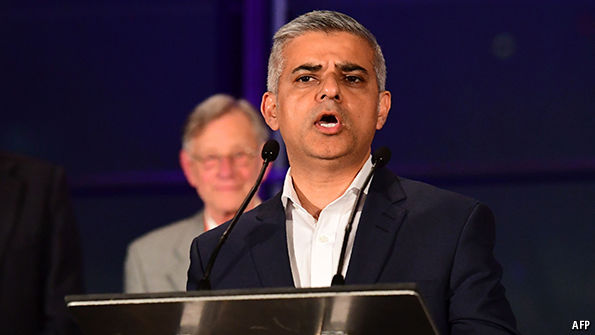
 “Congratulations @SadiqKhan 4 being elected mayor of
London,” tweeted Bilawal Bhutto, leader of the opposition Pakistan
People’s Party and son of former prime minister Benazir Bhutto.
“Congratulations @SadiqKhan 4 being elected mayor of
London,” tweeted Bilawal Bhutto, leader of the opposition Pakistan
People’s Party and son of former prime minister Benazir Bhutto.