Friday, 27 November 2015

Adele's '25' sells over 3 million copies in less than a week


adele iheartradio
Adele's soulful record, "25" has crossed 3 million sales in a single-week, a threshold other artists has ever come close to.

The only thing that can outmatch Adele's voice is her sales.

The singer's latest album, "25," surpassed 3 million in U.S. sales on Wednesday, according to Nielsen Music -- a sales-week threshold that is completely unheard of for the music industry.
The big numbers easily smashed the sales-week record held by *NSYNC's "No Strings Attached," which sold 2.4 million in 2000.
Adele blew through projections that had her week totals at 2.8 million to 2.9 million.
Her number could grow even larger seeing that Nielsen Music tracks sales to end of day Thursday.
The week's final numbers will be reported on Sunday.
 
The sales streak comes at a time when the music industry is fragmented, streaming music services are catching on, and album sales have been slowing down.
Adele has been at the center of the streaming music debate when she held "25, which was released last Friday, from streaming music services like Apple Music and Spotify.
The numbers also come one year after Taylor Swift's "1989" -- which some music industry observers argued could be the last platinum album ever.


Adele's fans had another reason to be thankful Thursday as the British singer announced a European tour via Twitter.
"Hello, it's me, Adele," the singer said announcing the tour before breaking out into laughter. "God, I can't even say that anymore."
The tour will make stops in London, Dublin, and Berlin starting next year.

Source: CNN 

Photo: Check out Agbani Darego's hot Abs during Workout Session

theSummons Frontpage's photo.


Agbani Darego showed off very impressive abs in this photo. No wonder many people insist that she will always be a beauty queen.
Darego was the first African to win the Miss World Beauty Pageant.
In 2001, Darego was crowned Most Beautiful Girl in Nigeria. Later that year, she became the first native African to claim the Miss World title.
That year, she was also awarded MFR title.

Thursday, 26 November 2015

Adele's '25' Became 2015's Best-Selling Album In Just 3 Days


Adele in a screenshot from her “Hello” music video (courtesy of XL/YouTube).

It sounds almost too incredible to be true…but then again, this is Adele, so anything is possible.
The British superstar’s new album, 25, has become the best-selling release of 2015, and it managed to do so in just three days. According to Nielsen, the album sold at least 2.3 million copies by Monday morning, which puts it well ahead of any other album’s numbers this year. If by-the-hour sales figures were public, it would be possible to figure out if it actually took less than three days for Adele to end up on top, but we may never know.

Before 25 arrived, Taylor Swift’s 1989 was 2015’s best-selling album, a title it earned last year. Back when the music industry still wasn’t sure if Adele was even going to release an album, it looked like 1989 might have been the rare record that was popular and powerful enough to be named the best-selling album two years in a row, but now that is no longer a possibility.

So far in 2015, Taylor Swift’s pop blockbuster has shifted around 1.8 million copies. Last year, in just a few months (it was released in October), the record moved over 3.5 million units, thanks mostly in part to her two massive number one hits, “Shake It Off” and “Blank Space.” While 1989 is slowly working its way down the charts—it just left the top ten recently after spending an entire year in the highest tier of the Billboard 200—it is possible that another single and the holiday season will propel it past the 2 million sales mark in 2015.


2015 has obviously been a fairly slow year for music sales, as aside from 25, no album released this year has been all that close to Swift’s 1989. The fourth quarter is typically when many of the biggest stars release their albums, but there aren’t currently many enormous projects expected, as plenty of labels rescheduled their drops to work around Adele’s schedule. A few artists have had especially impressive years in terms of album sales (Justin Bieber, Drake, The Weeknd), but none of them are likely to make a serious play for second place on the year-end list.
 Source: Forbes

Study shows that Breastfeeding Helps Lower Risk of Cancer and Diabetes

 
Two new studies have revealed that breastfeeding is not only good for babies it is also good for mothers because it protects women from breast cancer and Diabetes. One study suggests that breast-feeding may act as a sort of reset button for metabolism after pregnancy, helping women who had gestational diabetes avoid becoming lifelong diabetics. Breast-feeding may also promote cardiovascular health, including a healthy blood pressure. Dr. Eleanor Bimla Schwarz, a professor of medicine at the University of California, Davis said “This is a win-win — it’s good for the baby, too. “For all the women who want to do something to reduce breast cancer, this is doable. We need to make sure that’s part of the debate. Dr. Marisa Weiss also added that “The breast gland is immature and unable to do its job — which is to make milk — until it goes through the bat mitzvah of a full-term pregnancy. “Breast-feeding forces the breasts to finally grow up and get a job, and make milk, and show up for work every day and every night, and stop fooling around.”

Einstein’s general theory of relativity


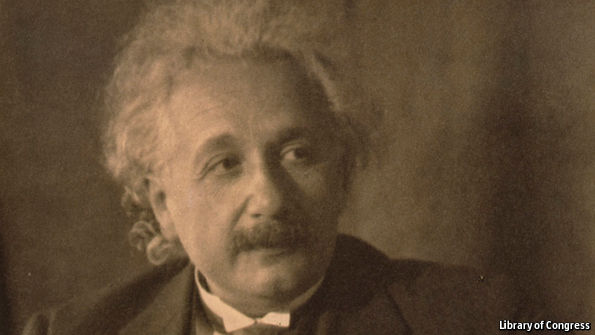
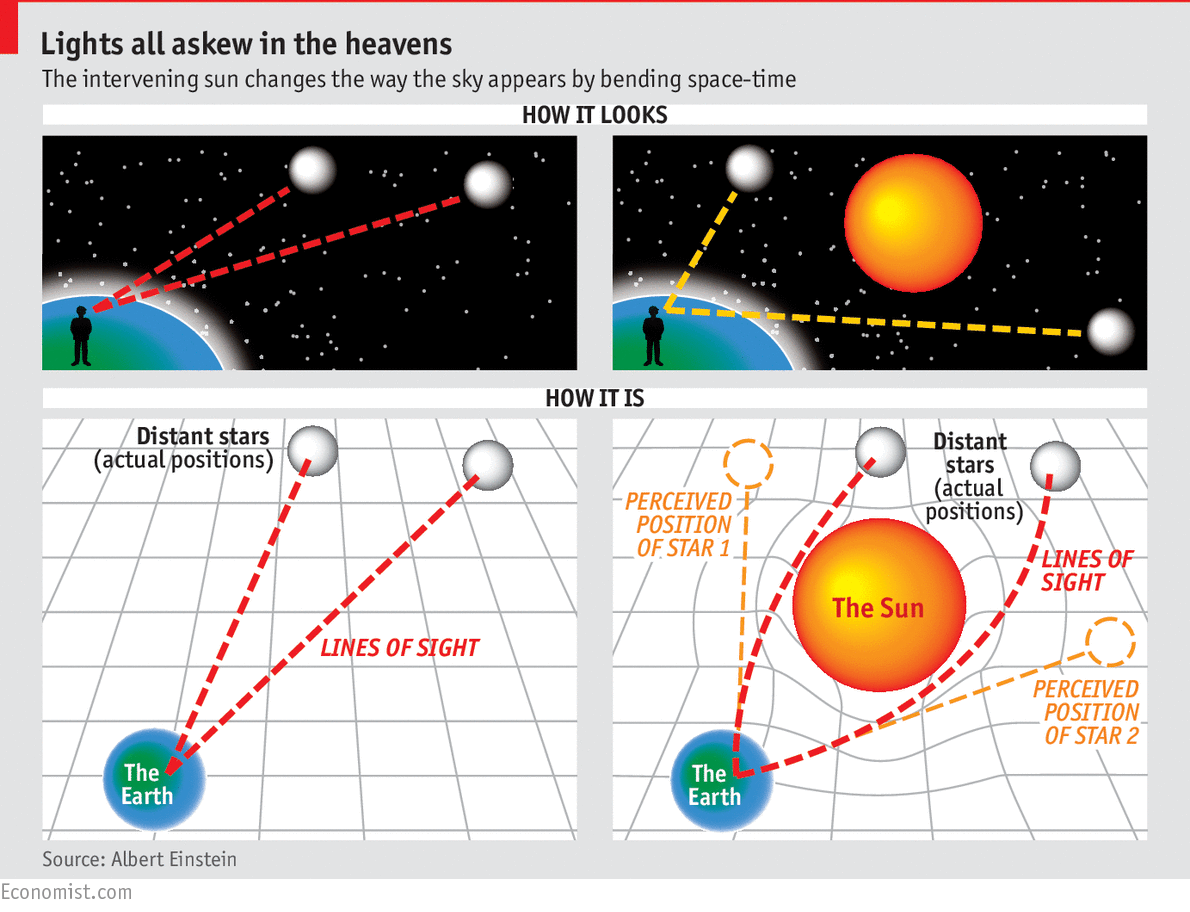
ONE hundred years ago, on November 25th 1915, Albert Einstein presented his freshly finished general theory of relativity to the Prussian Academy of Sciences. It was the outcome of nearly a decade's dedicated work. He showed that the theory solved a 150-year-old problem: each year, Mercury's closest point of approach to the Sun was moving forward more than it was expected to. All manner of explanations had been put forth, including an unseen planet called Vulcan, but relativity did the job perfectly. In 1916, Einstein predicted that relativistic effects would cause the apparent positions of stars to change during an eclipse, as the sun bent the distant stars' rays. That prediction was proved right in 1919, in a widely publicised expedition that propelled Einstein to global fame. But what exactly is his general theory of relativity all about?
Generally, it is about gravity. In 1905, Einstein had put forth his special theory of relativity, which concerned itself with objects and experimenters travelling at speeds near that of light. Einstein took this to be an absolute speed limit. His flash of insight was to fuse the three dimensions of space with that of time and create a single, mutable whole: spacetime. To make sure that light was always seen to move at light speed, the theory predicted weird effects like the shrinking of physical extent or stretching of time as objects got faster. Counterintuitive though it was, the theory worked. But as its name suggests, it was a special case—for movement at constant speeds in straight lines. Einstein knew, for example, that his ideas didn't match up with Isaac Newton's theory of gravity, which presumed unchanging dimensions of space and made no mention of time.
His quest to crack this problem began as he sat working at the Swiss federal patent office, having what he later described as "the happiest thought of my life": someone falling off a roof does not feel his own weight. That objects in free-fall do not experience gravity was a hint that gravitation and acceleration were identical. Einstein imagined a person in a cabin in outer space (this being long before manned spaceflight, he conjured a "spacious chest resembling a room") being pulled along in such a way that the person inside would find the situation indistinguishable from that on earth. Gravity not only looked like acceleration, he concluded; it was acceleration. But what provides that acceleration? Einstein's great insight this time was that it is an effect of mass actually stretching spacetime, creating a kind of dip into which objects fell, or circled, as around a plughole. Matter is not pulled by gravity, it falls along the path of least resistance, tracing out the shape of spacetime itself.
After the 1919 eclipse, general relativity lapsed into the shadows. Physicists were distracted by another flashy new theory, quantum mechanics, or working on the physics of atomic nuclei, which was also booming. It was not until odd sources of radio waves, eventually called quasars, were discovered in the late 1950s that general relativity started to stage a comeback. Quasars, it emerged, represented black holes, a theoretical outcome of relativity that even Einstein thought too weird to be true. By now they are taken to be fundamental constituents of the cosmos and to lie at the centres of most galaxies. General relativity has become an essential tool for all manners astronomical and cosmological, right back to the beginning of the universe itself. It is used to correct satellite-navigation data (for satellites experience a slightly different spacetime-stretching in orbit than you and your smartphone do) and to plan the kinds of space missions that can steer a space probe with 150-km precision past Pluto, nearly 5 billion km away—as the New Horizons mission did in July. Relatively speaking, Einstein's has become a fabulously successful theory.

Africa's 50 richest in 2015