
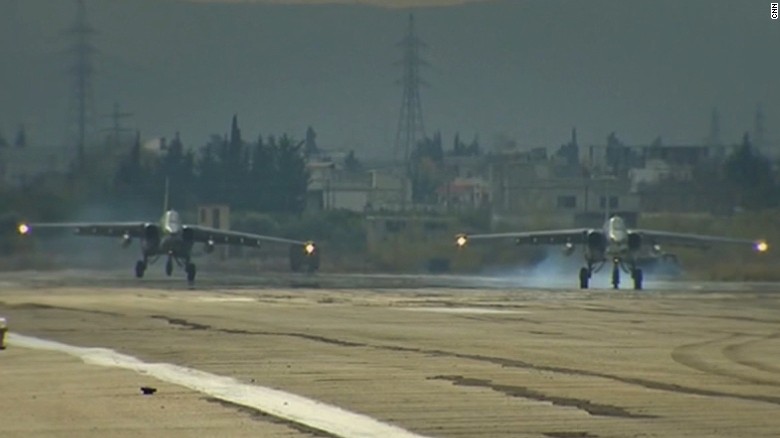
Inside look at Russia's military operation in Syria 02:42
Story highlights
- U.N. Envoy to Syria says, "It will be complicated. But it will be possible."
- U.N. Security Council approves resolution calling for free elections in Syria within 18 months
- Friday's meeting of the International Syria Support Group seeks to put in place a peace plan reached by ministers last month
(CNN)The
United Nations Security Council on Friday approved a resolution that
supports international efforts to seek a political solution in Syria.
U.S.
Secretary of State John Kerry said the process is designed to end the
nation's civil war and provide a new government in Syria.
Russia
and the United States both approved the resolution, even though it
doesn't address the major issue separating those two nations: What will
happen to Syrian President Bashar al-Assad? Russia supports Assad but
the United States wants him removed.
Still,
the accord was hailed as a major step toward bringing peace to Syria,
where a civil war has killed thousands and sent millions of refugees
fleeing into other nations.
"It's going to be uphill," said U.N. Envoy to Syria Staffan de Mistura. "It will be complicated. But it will be possible."
"This
council is sending a clear message to all concerned," Kerry said. "The
time is now to stop the killing in Syria and to lay the groundwork for a
government the people of that battered land can support."
Besides
recognizing the 17-nation International Syrian Support Group's efforts
in the peace process, the resolution provides a rough timeline for
political change in Syria.
It calls for
"credible, inclusive and nonsectarian governance" within six months and
"free and fair elections, pursuant to the new constitution," within 18
months.
The resolution, which passed 15-0, seeks a ceasefire in Syria. Kerry said that ceasefire would not include ISIS.
Kerry
said some Security Council nations disagree on Assad's future but that
nations involved in writing the resolution didn't want that issue to
stop the peace process. Ending the war and bringing political stability
to Syria go hand in hand, he said.
"If the war is to end, it is imperative that the Syrian people agree on an alternative in terms of their governance," he said.
Russian
Foreign Minister Sergey Lavrov warned against the "demonization" of
Assad, which he said happened to leaders like Moammar Gadhafi in Libya,
who ended up being killed. That would not help the peace process, he
said.
The resolution has a schedule for changing the political situation in Syria.
"We hope this process will not be protracted ad infinitum," Lavrov said.
Senior
State Department officials told CNN that Kerry and Lavrov led
negotiations Friday to fine-tune the text of the U.N. resolution.
Friday's
meeting of the International Syria Support Group, or ISSG, the third in
six weeks, sought to put in place a peace plan reached by ministers
last month in Vienna under the umbrella of the United Nations.
The
resolution does three things, which internationalize efforts to seek a
political solution in Syria. It endorses the 17-member ISSG as the main
body dealing with the Syria peace process; validates the peace plan
agreed to by the ISSG in Vienna last month, including a ceasefire
between the regime and opposition in six months and talks leading to
drafting a new constitution; and gives the United Nations a leading role
in working with the regime and opposition on negotiating a ceasefire
and drafting a constitution, which officials said is aimed at putting an
international stamp on the peace process.
Diplomats
close to the talks said Friday that there is heated discussion among
the nations in the meeting about the list of groups that will be
considered terrorist groups and unable to take part in talks.
But they said it was unlikely to affect passage of a U.N. resolution giving international endorsement of the peace process.
"The consensus is that they won't reach consensus on the terrorist list today," one of the diplomats said.
Spurred
on by the deadly attacks in Paris, the 17 nations overcame their
differences on how to end the civil war in Syria and agreed to the road
map for a political transition now being worked on.
The
United States and Russia have long split on the best path forward in
Syria. The United States supports groups warring with Assad, a close
Kremlin ally. Moscow, meanwhile, has been bolstering Assad with
airstrikes ostensibly aimed at ISIS but more often, according to the
Pentagon, targeting other opposition fighters, including ones supported
by Washington.
Not only have Russian
military strikes had a minimal effect on ISIS, being mostly focused
elsewhere, they have also exacerbated an already dire humanitarian
crisis.
But an increasingly bloodied
Russia -- now a target of ISIS -- and growing U.S. urgency in resolving
the 5-year-old conflict whose chaos only strengthens the terror group,
seems to provide some common ground for finding a resolution to the
conflict.
After holding marathon
meetings in Moscow with Russian President Vladimir Putin and Lavrov,
Kerry said the United States and Russia hoped to enshrine the
agreed-upon road map for an end to the civil war in a U.N. Security
Council resolution.
The
United States hopes a ceaseire between the regime and Syrian rebels
would allow Russia, along with the U.S.-led coalition of Arab and
Western allies, to focus on fighting the jihadists.
"You can't defeat Daesh without also de-escalating the fight in Syria," Kerry said in Moscow, using another name for ISIS.
State
Department Spokesman John Kirby said Friday's meeting seeks to "better
define" what a political transition in Syria would look like and how a
ceasefire could be implemented and monitored.
Still
undecided is which rebel groups should be part of the negotiations
between the regime and the opposition, expected to start in early
January.
Friday's talks follow a
meeting last week in Saudi Arabia in which Syrian opposition groups
agreed to unite to negotiate with the regime on a ceasefire. The Kremlin
has rejected the results of the meeting in Riyadh, saying it considered
some of the rebels present terrorists.
The
question of whether Assad could take part in the political transition
continues to be a main sticking point. For the past four years, the
United States has sided with Gulf States in calling for Assad's ouster.
But
this week in Moscow, Kerry raised eyebrows when he said "the United
States and our partners are not seeking so-called 'regime change,' as it
is known in Syria."
Some viewed
Kerry's statement as an effort to placate his Russian hosts. Kerry did
add that the United States still did not believe Assad "has the ability
to be able to lead the future Syria," and soon after his remarks, the
State Department said the U.S. policy that Assad should go remained
unchanged.
Russia is now agreeing to
the drafting of a new constitution and new elections, a position that
has evolved over the last few months.
But
Fred Hof, a former top U.S. diplomat handling Syria now at the Atlantic
Council, warned that regardless of Assad's fate, until Russia and Iran
are willing to press him to stop bombing the Syrian people, there is
little hope the political process will yield any results and that the
bloodshed will end.
"Stopping the mass
murder is a good place to start," he said. "How the hell do you sit down
for a peace process featuring compromise when one of the parties
doesn't accept the rules of the game and the other party's constituency
is being blown away on a daily basis?"
He
continued, "The first symptom of Assad being under control would be an
end to the collective punishment and mass homicide and only then would
the Syrian people truly have a chance to decide their fate."
No comments:
Post a Comment
Drop a comment and share your views with the world