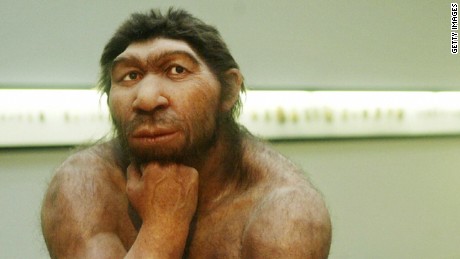
- People living in South Asia have DNA from Denisovans, an early hominin, new research finds
- The genes we borrowed from ancestor cousins may have helped us adapt to new environments but reduced our fertility
(CNN)Your ancestry can reveal a lot about you, including how related you are to cave men.
If
you have Chinese heritage, you might have slightly more Neanderthal in
your genome, while a new study finds that people from South Asia have
more Denisovan, another type of early human, in their DNA.
Evidence
started to emerge in 2010 that our distant ancestors interbred with
Neanderthals, the Stone Age hominins who populated Europe until around
40,000 years ago. We can all, with the exception of African people,
credit Neanderthals for around 2% of our genome. (Our ancestors
apparently started hooking up with their stocky cousins after moving out
of Africa.)
Now it seems
Neanderthals were not the only interbreeding game in town. The new study
finds that Denisovans interbred with the distant ancestors of people
living in what is now South Asia, including India, Bangladesh and
Pakistan. Previously the only people known to have detectable traces of
Denisovan DNA were in Papua New Guinea, Australia, China and other parts of East Asia.
The inter-hominin mating, both with Neanderthals and Denisovans, seemed to bestow our ancestors with advantageous traits, such as thicker hair (thanks, Neanderthals) and ability to live at high altitudes
(courtesy of Denisovans). However the new study suggests that there
could also have been evolutionary downsides to interbreeding, such as
reduced fertility.
"The
South Asia finding was a bit of a surprise. It is not explainable by
what we know about human history," said Sriram Sankararaman, assistant
professor of computer science and human genetics at the University of
California-Los Angeles. Sankararaman is the lead author of the study, which was published Monday in Current Biology.
Researchers
had been thinking that our ancestors could have picked up Denisovan DNA
just once, when one population of our ancestors intermingled with one
population of Denisovans, and then the descendants moved to East Asia
and the Pacific Islands. Although that still could have happened,
Sankararaman said these findings also raise the possibility that Homo
sapiens made babies with Denisovans in three different areas, including
South Asia.
The current study and
previous research suggest that we can no longer think of our ancestors
as interbreeding with other hominins only once, said John Hawks,
professor of anthropology at University of Wisconsin-Madison. "It is
happening repeatedly, wherever modern humans are coming into contact
with these archaic people," said Hawks, who was not involved in the
current study.
Of all the
nationalities today, Papua New Guineans and Australians can claim the
most Denisovan DNA, about 5% of their genome, followed by South Asians,
and then East Asians and Native Americans, all at around 2%. Europeans
have no detectable Denisovan DNA.
What's in your caveman genes?
Looking
at the kind of Neanderthal or Denisovan DNA we possess "is a first step
to understanding the (genomic) regions which might have been important
for modern humans," Sankararaman said. We can also learn a lot from the
regions of our genome where cave man DNA is glaringly absent.
The current study found some of the most prevalent Neanderthal genes are associated with thicker skin and hair, just as previous research concluded.
"You
have humans that lived in Africa, and now they are going into different
environments in the world and there are already populations (of
Neanderthals and Denisovans) that adapted to those environments. And so,
for the modern humans it almost makes sense that they borrow the genes
from them," Sankararaman said.
The
study also found evidence that our ancestors may not have passed on
certain parts of the genome from their hominin cousins, such as a less
evolutionarily advanced version of the FOXP2 gene, which is thought to
play a role in language and speech.
"We
all agree there has been positive and negative selection. ... It is
interesting that similar regions in both Neanderthal and Denisovans,
like FOXP2, had negative selection," said Rasmus Nielsen, professor of
evolutionary biology at University of California-Berkeley, who was not
involved in the current research.
Another
group of genes that seems to be avoided by early humans, from an
evolutionary standpoint, is involved in reproduction. This finding
suggests that the offspring of an early human and Neanderthal or
Denisovan pairing could have been less able to procreate and pass on
their genes. If interbreeding reduces fertility, Hawks said, "that
creates the expectation that maybe (these three hominins) were different
species," which has been a matter of debate.