Showing posts with label CNN. Show all posts

Tuesday, 30 August 2016

French mayor on burkini ban: Muslims must accept our way of life

The Mayor of the French town of Riviera, Marc Etienne Lansade has told Muslim beach goers not to come to his town if they aren't prepared to accept their way of life by not wearing burkinis to beaches.
"If you don't want to live the way we do, don't come. You have to behave in the way that people behave in the country that accepted you, and that is it," Mayor Marc Etienne Lansade told CNN.
"If you are accepted in Rome -- do like Romans do," he said, adding, "go in Saudi Arabia and be naked and see what will happen to you."

Lansade, alongside several other mayors in France maintains that burkinis have been banned in his town despite a ruling by France's highest administrative court that mayors do not have the right to outlaw burkinis.

The court ruling comes after more than 30 French towns banned the burkini, a swimsuit which covers the whole body except for the face, hands and feet and is worn mostly by Muslim women.
 

Monday, 22 August 2016

Doctors remove 40 knives from man's stomach in India


A man in India spent two months swallowing knives and had 40 of them surgically removed from his stomach, according to the doctor who led the operation.
"He had a wild urge to consume metal. Even for us, the experienced surgeons, it was frightening," Dr. Jatinder Malhotra told CNN.
"We were so nervous... a small mistake could have taken the patient's life. In my 20 years of practice, I have never seen anything like it."
Malhotra said it took his team about two days to form a diagnosis and surgery plan.
The five-hour operation took place Friday in the northern Indian city of Amritsar, a Sikh holy city in the state of Punjab.
Malhotra said they found foldable knives, which when fully extended were about seven inches long.
"He [the patient] says he swallowed some knives folded, and some unfolded. When we took out the knives -- some were found folded, some were open, and some had even started rusting and were broken," Malhotra said.
The patient, a 42-year-old father of two, told CNN he's feeling much better.
"I'm sorry I let my family down. I'll be forever thankful to doctors and hospital staff for saving my life," he said.
Malhotra says the patient is now "out of danger" and is set to be discharged in a couple of days.
He won't be discharged until he's cleared by psychiatrists, which is set to happen in a couple of days, two doctors at the hospital told CNN.
But the big question remains -- why did he start eating knives?
"I don't know why I used to swallow knives," the patient told CNN. "I just enjoyed its taste and I was addicted ... how people get addicted to alcohol and other things, my situation was similar."
Malhotra believes the patient has a very rare mental disorder that most likely has not been published in any international medical journal.
The patient is currently under the continuous supervision of the hospital's in-house psychiatric team and will soon be visited by independent mental health experts, doctors said.
The patient told doctors that he has no idea why he started eating knives but that he "developed a taste for metal" and "loved the way blades tasted."
The patient even managed to keep his habit secret from his family, according to Malhotra.
Now, Malhotra says, the patient claims he won't even touch a knife anymore.
"I will never do such acts ever again," the patient said. "I'm a new person now."
If the urge does strike, Malhotra and his team gave him some advice -- "we told him if you ever feel like you need more iron in your body, try spinach."
 
(CNN)

Thursday, 18 August 2016

Sharia law: what you need to know about it


Republican presidential nominee Donald Trump says he wants to test Muslims coming into America to make sure they don't want Sharia law to supersede the US constitution. Meanwhile some states have passed, or are trying to pass, laws to curb the possibility of Sharia law making its way onto the books in the US.
With the rise in recent years of both radical Islamic terrorism and anti-Muslim bigotry, Sharia -- or Islamic religious law -- has become a hot topic of debate.
Some of its harsher versions can demand women clad in all black, adulterers being stoned and thieves getting their hands cut off. But Sharia governs many other areas of Muslim life, such as prayer. And many Muslims, turning to Sharia for moral guidance, have more moderate and varied interpretations.
 
Here's what you need to know about Sharia:

What does its name mean?

The word Sharia means "the path," or "a road that leads one to water." It refers to a set of principles that govern the moral and religious lives of Muslims.
"Sharia represents how practicing Muslims can best lead their daily lives in accordance with God's divine guidance," according to Teaching Tolerance, a project of the Southern Poverty Law Center.

What's in Sharia?

Sharia is based on Islam's holy book, the Quran, and the life of prophet Mohammed. The majority of it concerns the faith of the individual and how to practice Islam, along with guidance on when to pray and how to fast during Ramadan.
Shariah law, according to Muslims, includes "the principle of treating other people justly, of making sure that the financial system treats people fairly ... and most importantly the basic principles of Islamic fate," says Harvard Law professor Noah Feldman.
It encompasses things like marriage, divorce, inheritance and punishments for criminal offenses.

Is it one law, or many?

While the Quran and the life of the prophet make up Sharia, its interpretation is called 'fikh' and is done through Muslim scholarship. Most practicing Muslims take their cues about their faith from Sharia, but it is not practiced uniformly.


Its implementation varies greatly across the Muslim world. A Pew religious landscape survey found that 57% of American Muslims say there is more than one way to interpret Islam's teachings.
Terror groups such as ISIS are trying to implement a brutal version of Sharia law, but millions of Muslims are guided by a much more moderate interpretation.

Where is it practiced?

Sharia has been applied in varying degrees and with great diversity in practice -- both by individual Muslims and predominantly Muslim countries. While both Saudi Arabia and Iran claim to be ruled by Sharia, they differ greatly in how they implement its laws.
When asked about how they want their nations' laws crafted, many Muslims are comfortable with Sharia governing family law but don't want to see severe corporate punishment implemented.

What do American Muslims want?


Most Muslims enjoy the religious freedom they need to practice their faith, which is guaranteed by the US constitution.
"It doesn't consume my life that I want to make it the governing law of the country I live in. I am very content to live in the US under the constitution," says retired Lt. Col. Shareda Hosein in an interview with CNN. "And for me the constitution affords me my freedom of religion, which is the most important thing for me and other Muslims."
 
(CNN)

Wednesday, 17 August 2016

Escaped Chibok girl: I miss my Boko Haram husband

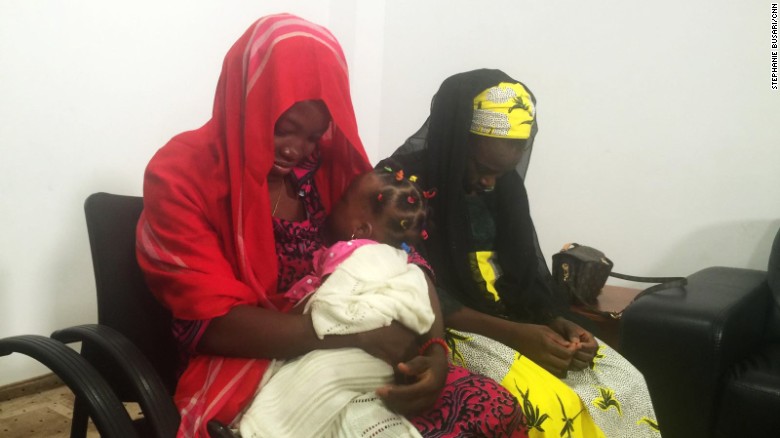
Chibok girl Amina Ali Nkeki (in red), who was kidnapped by Boko Haram, with her baby daughter.Amina Ali Nkeki, her husband and their daughter escaped from a Boko Haram camp in May. "I'm not comfortable with the way I'm being kept from him," she told CNN.


Escaped Chibok girl Amina Ali Nkeki says she misses her Boko Haram fighter husband and is still thinking about him three months after escaping the militants' camp.
Amina Ali, who was held hostage by the terrorist group for more than two years, says she was married off a year into her ordeal and later had a baby girl, Safiya.
The couple and their daughter were found on the outskirts of Nigeria's Sambisa Forest in May. She says they fled the camp by themselves and were not rescued by the Nigerian military, contrary to reports.
Her husband, identified as Mohammed Hayatu at the time of their escape, told a witness that he too had been kidnapped by Boko Haram.
He was placed in military detention for interrogation by Nigeria's joint intelligence center.
Amina Ali was found with a suspected Boko Haram terrorist named Mohammed Hayatu.
Amina Ali says she has no idea where he is now and is keen to be reunited with him.
"I'm not comfortable with the way I'm being kept from him," the painfully shy 21-year-old told CNN in her first worldwide interview, at an undisclosed location in Abuja Tuesday.
Addressing the father of her child directly, she says: "I want you to know that I'm still thinking about you, and just because we are separated doesn't mean I have forgotten about you." 
 
Her statements came two days after the terrorist group released a grisly video showing the dead bodies of young women, taken in the aftermath of what Boko Haram says was a Nigerian airstrike.
Amina Ali says a dozen captives died in a bombing more than a year ago, which suggests that the footage is not new, according to a spokesman for Nigeria's National Security Advisor.
The video also shows a Chibok girl reciting a scripted plea for the release of Boko Haram fighters in exchange for the kidnapped girls.
Amina Ali was one of 276 schoolgirls abducted at gunpoint from their boarding school in Chibok in April 2014, by Boko Haram fighters. As many as 57 girls were able to escape almost immediately, but more than 200 remain missing.
The kidnapping sparked global outrage and prompted global figures, including activist Malala Yousafzai and first lady Michelle Obama, to support the campaign to #BringBackOurGirls.
Amina Ali refuses to talk about the attack, saying only she cannot remember what happened that fateful day.
For a year after they were taken, the abducted girls were kept together, she says. Then some of the teenagers -- including her -- were "given" to the terrorists as wives.
She says she was desperate to see her mother again and that the thought gave her the courage and strength to flee the camp.
Asked how she felt about becoming a mother herself while in captivity, her face clouds over and, speaking through an interpreter, she insists: "I don't want to answer."
 
Her mother has spent the past two months staying with her in the capital. But Amina Ali has still not been back to Chibok and says she wants to go home and return to school.
"I'm not scared of Boko Haram. They are not my God," she said.
Kidnapped Chibok girl meets the President of Nigeria


The whereabouts of the rest of the girls remain a mystery, though they are believed to be somewhere in the Sambisa Forest, a Boko Haram stronghold in the country's northeast.
The current Nigerian government has said via Facebook that it is in touch with Boko Haram and working to secure the girls' release.
Over the past two years, successive Nigerian governments have been criticized for failing to recover the young hostages.
"This is a government which is not only in denial mentally, but in denial about certain obvious steps to take," Nigerian author Wole Soyinka, a Nobel laureate who is often referred to as the conscience of his nation, told CNN's Chief International Correspondent Christiane Amanpour in May 2014.
"It's one of those rather child-like situations that if you shut your eyes, if you don't exhibit the tactile evidence of the missing humanity here, that somehow the problem will go away," he said.
Amina Ali remains the only long-held hostage who has escaped.
But she has a defiant message for her "sisters" still being held: Don't lose hope. She managed to get away, she says, and one day they will be able to return to their families too.
"Be patient and prayerful," she said. "The way God rescued me from Sambisa Forest, he will rescue you too."
 
CNN