A Palestinian Teacher’s Methods Earn the Attention of More Than Her Class
A Palestinian Teacher’s Method
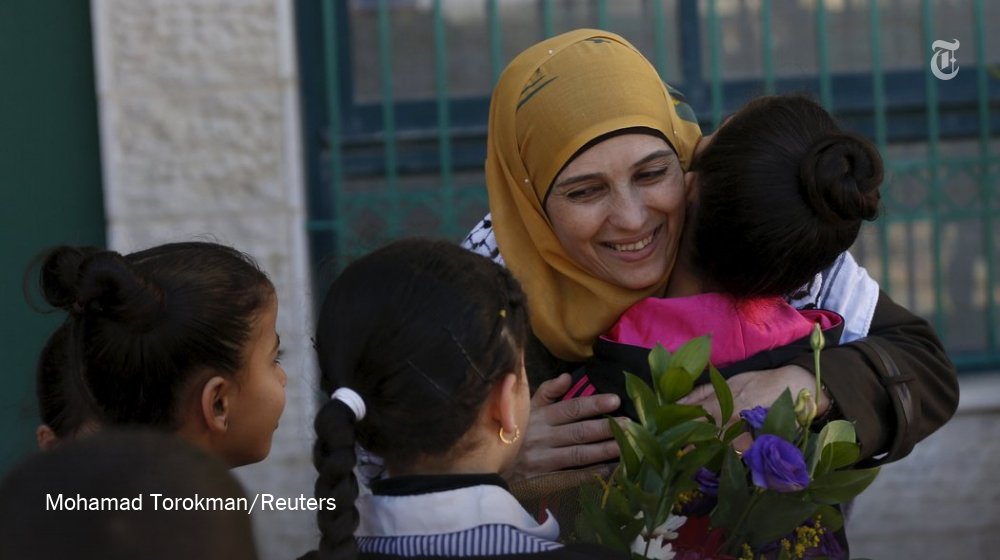
Hanan Hroub, an elementary-school
teacher, with her students in the West Bank city of Ramallah in
February. She recently won a $1 million global education prize.
EL-BIREH,
West Bank — The noise signaled that Hanan Hroub’s second-grade students
were not focusing on their assigned task of scrawling math problems on
balloons. Instead, they were staring at the latest interloper, a tall
German journalist, treading through their classroom to meet their
“Miss,” as Palestinians call teachers, who recently won a $1 million global education prize.
And they were popping those balloons.
Since
the prize was announced March 13, Palestinian officials have honored
Ms. Hroub with festivals and honorary degrees. International reporters
have raced to her house and classroom. Some Israelis have denounced her
as part of a Palestinian education system they see as inciting violence,
and noted with dismay that her husband assisted in the killing of six Jewish settlers in the West Bank city of Hebron in 1980.
Amid
all that hubbub, Ms. Hroub, 43, still faced the essential challenge of
every elementary-school teacher: keeping children on task. On the
morning of the balloon exercise, she had put four marks underneath a
frowning yellow face pasted to the whiteboard. The smiling face next to
it had only a single mark.
“No,
Miss! No! We will concentrate, we promise!” piped up a girl named
Shurouq. Ms. Hroub and her charges discussed why they felt distracted,
and promised to do better.
Ms.
Hroub had just returned to school from Dubai, in the United Arab
Emirates, where she received the prize from the Varkey Foundation in a
ceremony involving Vice President Joseph R. Biden Jr. and Prince
William, as well as Pope Francis by video.
The
foundation said she had been selected from the original 8,000 nominees
for teaching methods built around educational games that she created for
children traumatized by violence. The award came at an awkward time:
Palestinian teachers, including Ms. Hroub, had been on strike for weeks,
demanding better pay. (The Palestinian Authority acceded to a 10 percent salary increase hours after the prize was announced.)
A
mother of five children, now age 18 to 23, Ms. Hroub said she developed
her play-therapy approach to education for her own children, after
Israeli soldiers shot at their family vehicle at a military checkpoint
near Bethlehem in 2000. Ms. Hroub said she was not in the car and did
not know why the soldiers opened fire, but that her husband, Omar, who
had spent a decade in Israeli prisons, was wounded.
After
the episode, she said, her children often woke up screaming at night,
and became aggressive. “The teachers at their schools weren’t trained to
deal with that, and I feared that I was losing my children,” she
recalled.
Over
time she realized that her children were at their calmest and happiest
while playing. She began scrambling to think of games they could play
together. She built a games section in a corner of the house and told
the children that was their safe place.
During
that time, the violent years of the second intifada, the Israeli
authorities imposed curfews on the Bethlehem area where she then lived.
When the curfews were lifted, sometimes briefly, “other women raced to
buy food,” she said. “I raced to the news agency to buy papers, crayons,
markers, whatever I could to make games for my children.”
Having
seen how much the games helped her children to cope, Ms. Hroub, who
grew up in Dheisheh, a cinder-block refugee camp in Bethlehem, decided
to become a teacher to expand their reach. She enrolled in college,
fulfilling a dream delayed in part by West Bank campuses having been
closed when she finished high school because of the first Palestinian
intifada, and has been at the front of a classroom since 2005. She has
refined her methods, frequently taking games from educational websites
and tailoring them to the Palestinian experience.
“Everything begins with an idea,” she said. “Then I tried it on my children, then in a classroom. Now, the world knows.”
Ms.
Hroub said she planned to use the $1 million prize money to create a
foundation promoting the games. While the Palestinian Education Ministry
has sent dozens of teachers to observe her classroom, she said the
method has not really caught on, something she attributed to a cultural
resistance by people who think play is frivolous.
“Every
year it’s the same,” she said. “The parents are in shock: Are our kids
playing at school? And then they start seeing results.”
Not test score results, emotional results.
She
pointed to a big-boned boy who was on the brink of being expelled for
bullying. The boy’s father begged Ms. Hroub to work with him and she
agreed, on the condition that the parents promise never to hit him. The
day of the balloon exercise, Ms. Hroub reprimanded the boy twice but
also showered him with praise when he completed his work. After he
snatched a pencil and pushed a girl, she gently sat him next to one of
the better-behaved students.
“This boy that you see today is a different child from the one who entered my classroom,” she said.
That
brightly painted classroom on the second floor of the tidy Samiha
Khalil School is a stark departure from the typical Palestinian
classroom of desks in neat rows. For math, the students ran around
holding numbers from 1 to 9, getting together in pairs that added to 10,
then knocked odd-numbered balls into a rabbit’s mouth to review odds
and evens.
At
story time, Ms. Hroub donned a rainbow-colored wig over her Islamic
head scarf and pinched on a red clown nose, reading about a naughty
spider named “Sha-sha-sha-sha-ban.”
She
prodded the children toward what she called “peaceful” ways of
disagreeing, including with her. One child dissented from her decision
to move him after hitting a classmate. “You oppressed me, Miss,” said
Laith, 8. They talked it out.
Ms.
Hroub said she was not political and would welcome her practices being
instituted in Israeli classrooms. Yet, one wall of her classroom has an
enormous map of the region that does not acknowledge Israel’s existence.
As Ms. Hroub took the children on an imagined drive through Jerusalem,
they “toured” Muslim and Christian sites, but she made no mention of
Jewish ones.
Since
the prize was announced, some pro-Israel groups have criticized the
foundation online because Ms. Hroub’s husband — now a legal adviser to
the Palestinian Authority — was involved in the 1980 ambush of a group
of Israelis trying to revive a Jewish settlement in Hebron. (Some
Palestinian news sites have praised him as the “mastermind” of the
attack, though a New York Times article at the time described him as having assisted.)
Others
complained that any Palestinian teacher was honored. Itamar Marcus,
whose Palestinian Media Watch chronicles anti-Israel and anti-Semitic
statements in the Arab news media and who has long complained that
Palestinian schools educate students to hate, said that even if Ms.
Hroub was an excellent teacher, the award would be seen by the
Palestinian Education Ministry “as a confirmation that what they are
doing is O.K.”
Mr.
Marcus complained that 25 Palestinian schools were named after
militants who had killed Israelis or Jews, and that youth sporting
tournaments similarly honored so-called martyrs. He said that videos
broadcast on Palestinian television showing schoolchildren praising such
attacks suggested what they were being taught to do so.
Jamal
Dajani, a spokesman for the Palestinian government, dismissed that
suggestion. “Palestinian children are constantly subjected to Israeli
soldiers and armed settlers waving guns in their faces,” he said. “This
is enough cause for incitement.”
Ms.
Hroub waved away questions on politics. “I’m a teacher. That’s me,” she
said. “I can’t change history, what happened before 10 or 20 years.”
Back
in class, Ms. Hroub ended the balloon-math challenge because it was not
going anywhere. To change the mood, she played a YouTube video of a
baby laughing, and the students collapsed into giggles. They threw their
balloons in the air, stomped on them and danced. They sang about a
Palestinian grandmother, and discussed dental hygiene. They quietly
settled into some language exercises.
With a grin, Ms. Hroub drew a mark under her smiling emoticon on the whiteboard.
“Another, Miss! We deserve another!” a girl called out.
She drew another two strokes, prompting cheers from the children: The happy and sad faces now had the same number.